
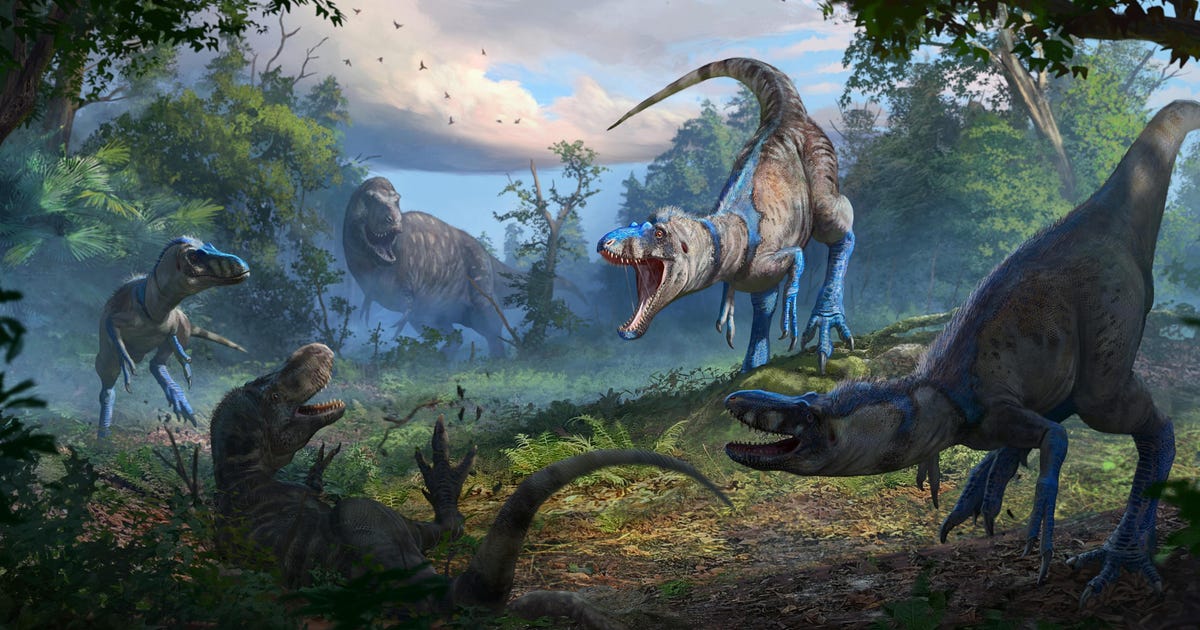
The tyrannosaur-type stamped on the land of Hell Creek in Montana, not causing the ground to shake and not terrifying mammalians for miles around. That is because it was small, no more than a couple of meters in height, and perhaps five meters long with the tail. Then it got into a fight with a Triceratops, and both of them lost. Then come the year 2025, it would blow all the theories about Nanotyrannuses and the great Tyrannosaur family at large out of the water.
The fossil of the Triceratops and a predator eternally locked in battle was found in 2006 in the Hell Creek fossil formation in Montana. The popular press called them the “dueling dinosaurs,” though one was a carnivorous aggressor and the other its herbivorous victim.
Now in October 2025, a fresh analysis of the duo has changed popular paleontology as we know it. There are a lot of “young T. rex” fossils out there who are no such thing, it seems.
One question engaging paleontologists since the discovery of Nanotyrannuses – tiny T. rex-type dinosaurs – in 1942 is whether they were a stand-alone species or juvenile T. rexes. It is true that Nanotyrannuses didn’t look entirely like tiny T. rexes, but then a fossil chick might not be understood as related to a fossil rooster, and the less said about amphibian metamorphosis and child-parent resemblance, the better.

Tilting your head back a bit, you could have looked Nanotyrannus in the eye. The Great and Mighty Tyrannosaurus rex could tower over six meters in height and you could look his knee in the eye.
So it seemed plausible that the one was the adult and the other the child, but over the years, the question of the relationship between T. rex and Nanotyrannuses had remained open because Nanotyrannus fossils have been both rare and in terrible condition – except for the one involved in the exceptionally well-preserved dueling dinosaurian fossil. Paleontologists who thought Nano was a separate species were slammed for failing to accept that the Nano exhibited a set of characteristics typical of immature tyrannosauroids.
Holy vindication. Now new analysis of the dueling dinosaurs and 200 tyrannosauroid fossils shows that the Nanotyrannus caught in the act of attacking a Triceratops was not a juvenile T. rex. It was a full-blown adult, according to a new paper published Thursday in Nature by Lindsay Zanno and James Napoli.

Ergo Nanotyrannus was indeed a stand-alone species that lived contemporaneously with T. rexes before the Cretaceous mass extinction that did for all the big dinosaurs around 65 million years ago.
Actually Nanotyrannus wasn’t a tyrannosaur proper at all, they write. In fact of facts there were two separate species (at least) of Nanotyrannuses that weren’t tyrannosaurs proper at all: Nanotyrannus lancensis and Nanotyrannus lethaeus. Pssh. Taxonomically, they “sit outside Tyrannosauridae.”
The discovery of Nanotyrannus lethaeus was a complete surprise. It came to light while they were analyzing the 200 tyrannosaur fossils – it had been thought to represent an immature T. rex.
Zanno and Napoli conclude that it wasn’t, it was a Nano that differed in some respects from the familiar lancensis. They named it after the River Lethe, the mythological river of oblivion or sheer forgetfulness, in Greek mythology, because the thing had been found decades ago and then just sat there in plain sight, “forgotten” for decades, they explain.
Styx, by the way, was the river of hate. Now you know.

We also now know that decades of research that used Nanotyrannus fossils to model T. rex development from egg to downy hatchling to towering titan have to be junked. So do the models of T. rex behavior on what could be deduced about N. rex behavior. Bye-bye. It is now clear that generations of studies connecting T and N. rex were based on two entirely different animals, the team concludes.
“This fossil doesn’t just settle the debate. It flips decades of T. rex research on its head,” Zanno said in a statement. No it isn’t embarrassing, it’s how newly discovered facts are added to existing ones to birth new theories that fit all the facts.
The new facts are, Zanno and Napoli detail at great length, that Nanotyrannus’ traits are not ontogenic, they’re adult.

Moreover, the almost complete specimen includes, for the first time, a forearm and the tail and they are not like those of the T. rex. Its paws were proportionally much longer, for one thing; it had proportionally longer toes too.
So what were nanotyrannuses if not a relation of the rex? Something else; a light-footed, fast-moving predator, with stereoscopic vision that diverged from the eutyrannosaurian branch early on.

Moreover, Zanno and Napoli posit that a host of other animals with other nomenclatures, including the Appalachian tyrannosauroids Dryptosaurus and Appalachiosaurus, were also nanotyrannuses.
Suddenly we’re losing a lot of rexes and gaining a lot of nanotyrannuses – cool. The researchers evidently anticipate blowback to their paper. “Our results undermine a nearly uniform consensus among theropod specialists and rectify a significant taxonomic error underpinning decades of research,” they write. Talk about setting a cat among the proto-pigeons.
Their new paper also puts paid, they explain, to one of the stranger theories bruited about – that the tiny skeletons of Nano (everything being relative) and the giant ones of T. rex imply that rexes experienced secondary metamorphosis, even though any metamorphosis is a condition confined to amphibia and invertebrates.
No. Baby T. rexes were born as small T. rexes that grew into big ones and if they had any connection with Nanotyrannus beyond an ancestral common root, it was that when rexes were still in tyrannosaurian childhood, they may have competed with the N. rexes over the food.
Or, it is possible that being very different animals, they occupied different gastronomic niches. Nanotyrannuses had very long back legs, like salukis – maybe they bipedally galloped like the wind, and went after animals that the king, the lumbering T. rex, simply could not.