
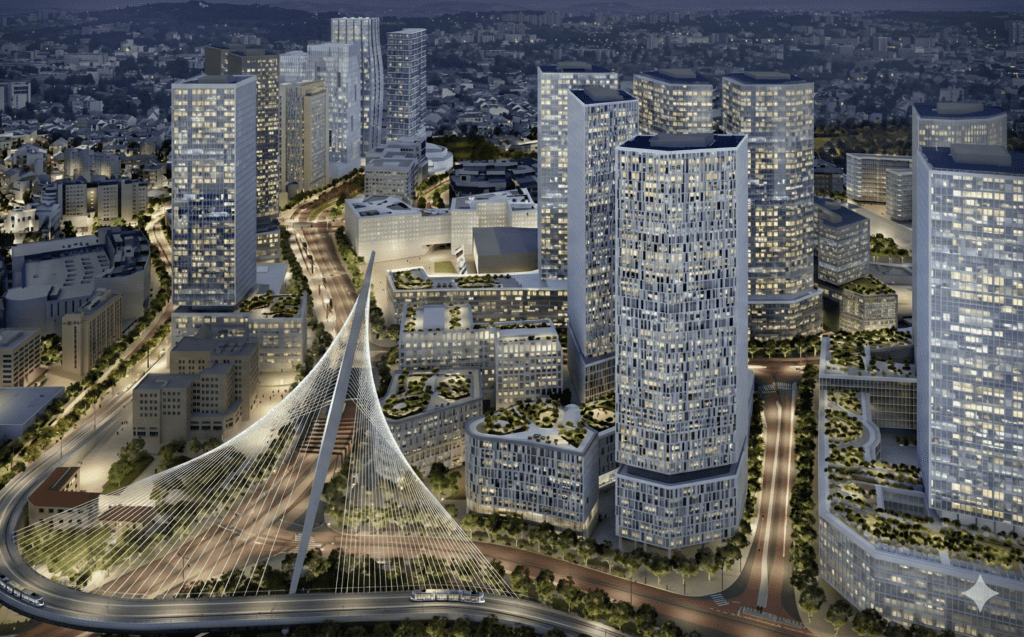
If you have driven into Jerusalem lately and felt like the skyline is quietly rewriting itself, you are not imagining it. Around the HaTurim light rail stop, the Yitzhak Navon rail station, and the Chords Bridge, a new central business district is forming. It is being built to function as a true “front door” for Israel’s capital, where commuters step off a train, ride a light rail, walk into an office tower, and spend the evening in a hotel, restaurant, or public plaza without needing a car.

The Jerusalem Gateway quarter is slated for roughly 20 towers, many rising up to about 40 stories, with total new construction around 1.2 to 1.25 million square meters. It is designed to include major office and commercial space, thousands of hotel rooms, cultural and public buildings, and an expanded convention ecosystem anchored by the Binyanei HaUma complex. City planners and project managers have repeatedly framed it as a jobs engine, with estimates of about 60,000 new employment opportunities once fully built out.

The district itself is being developed across roughly 700 dunams (173 acres) at the western entrance to the city, connecting offices, hotels, public space, culture and commerce into a dense urban fabric that planners hope will reshape how Jerusalem grows and works. Rough initial investment figures for the overall Gateway plan have pointed to around 1.4 billion shekels in public and private funding, with major tenders like the NIS 120 million award for two 40-story towers and an eight-story building already made by a consortium of Israeli developers.
The Gateway is being positioned as Israel’s largest integrated transportation hub, adjacent to the high speed rail at Navon, the Jerusalem Central Bus Station, and multiple light rail lines, plus bike infrastructure and a large underground public parking facility.

That transportation bet is now entering a visible new phase because the Green Line is approaching its first public launch. Trial runs have begun on the Malha to HaTurim segment, running around the clock during the testing period and not carrying passengers. The first stage is widely expected to open to riders soon, connecting major nodes like Malha, Givat Ram, and the government quarter, and strengthening the logic of placing a national scale business district right at the city’s entrance.
Marom Tower is the clearest symbol of where the project stands today. It is widely described as the first major office tower in the Gateway quarter to move from planning into real construction, with 40 stories and a direct connection to Yitzhak Navon station. The project is designed as a flagship office building, offering roughly 60,000 square meters of workspace alongside ground level retail, dining, and public areas, including a cultural component in the lower floors.

The official development bodies have been explicit that the district is meant to attract major Israeli and international firms and institutions, with design standards meant to match global business expectations rather than compromise on cost-cutting styles of prior projects.
Other projects marketed as part of the same entrance transformation include mixed use developments on Jaffa Street and Shazar Boulevard near the courthouse and government compounds, with residential towers alongside office space, commercial areas, and public plazas.

The Gateway is an attempt to correct a long running imbalance. Jerusalem’s economy has historically been under supplied in modern Grade A office clusters compared to Tel Aviv, even as the city grew into a major hub for government, academia, hospitals, and emerging tech. A district that sits directly on the intercity light rail line changes the commuting math for high value employers. It lets a company hire talent living along the rail corridor without forcing them into a car commute through the city entrance bottleneck.
On the ground, the build stage is already deep. Multiple towers are in excavation and foundation phases, and major infrastructure coordination is underway because the entire quarter is being assembled around live transportation corridors. This is one of the most complex construction environments in the country as the high speed train, light rail, bus terminal, arterial roads, and dense high rise foundations all compete for the same space.

The project comes along with its own unique set of risks and debates. Planners acknowledge that residents worry about a building spree changing the character of the capital for years. The Gateway’s answer is essentially that Jerusalem cannot expand its borders, so it must densify.
Will Jerusalem be able to really fill the sheer volume of new office and hotel space at the level the plan envisions? Only time will tell as this historic project unfolds.
Stay informed with the latest Jewish news, real-time Jewish breaking news, and in-depth Israel news coverage from our newsroom. For continuing updates, expert perspectives, and trusted reporting, visit our main news hub here.
Israel and the Middle East –
Jewish Politics –
Jewish Culture and Lifestyle –
Videos –
Jewish World
Source link