

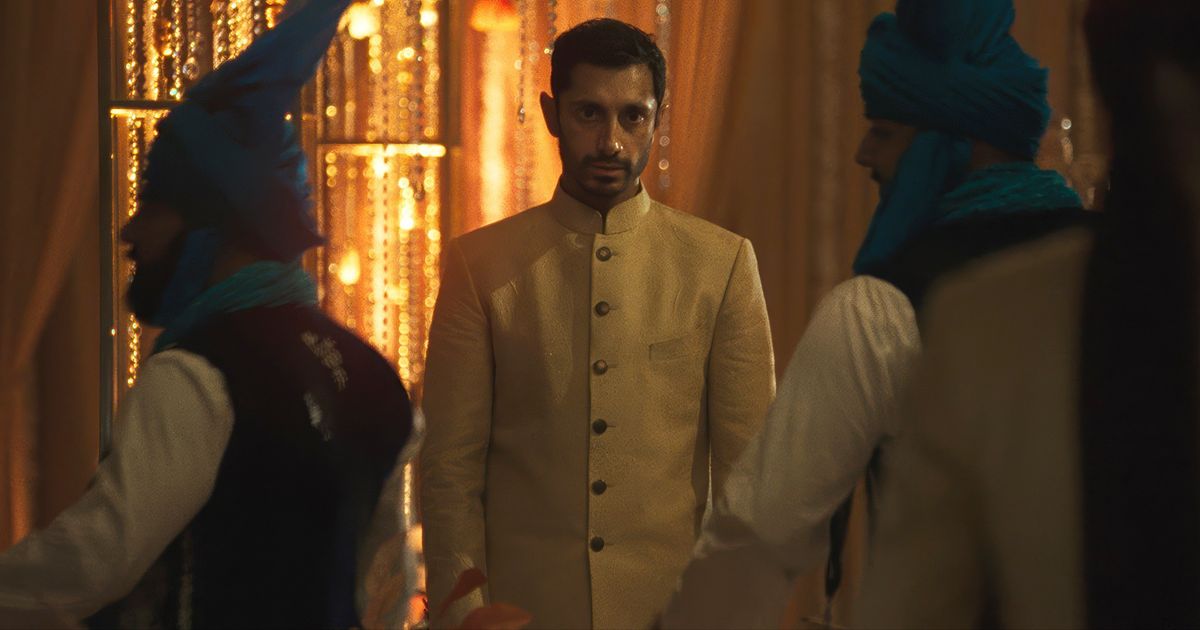

Hamlet has never gone away, but we seem to be at a rather ripe moment for its revival.
Photo: Vertical Entertainment/Courtesy Everett Collection
We know William Shakespeare’s Hamlet so well at this point that one of the primary pleasures of any new movie adaptation lies in seeing how the play’s various elements have been reimagined. In Michael Almereyda’s 2000 film, Ethan Hawke’s Hamlet delivered the “To be or not to be” soliloquy while perusing the Action aisles of a Blockbuster Video. Kenneth Branagh’s 1996 version had the actor-director delivering that same speech into a two-way mirror. In Laurence Olivier’s 1948 classic, he stood at the edge of a castle parapet, contemplating the thundering waves below. Last year, Chloé Zhao’s Hamnet (not an adaption per se, but still) nodded to Olivier by having Paul Mescal’s Will Shakespeare deliver these lines while standing forlornly at the edge of a riverbank — but then it gave us yet another variation, this time during our glimpse of the actual play in the picture’s final act; there, Noah Jupe, playing the movie’s stage Hamlet, sat at the edge of the proscenium and spoke calmly to the audience. The implication was clear: Hamlet, both play and person, can take almost infinite forms.
Now here comes director Aneil Karia’s new Hamlet, starring Riz Ahmed in the title role, with one of the more entertaining variations on “To be or not to be.” For this one, Ahmed (who in the movie plays the anxious British Indian scion of a rapacious modern-day real-estate-development firm) crouches behind the wheel of a speeding car careening down a dark highway as he spits out Shakespeare’s lines about suicide; then he frees his hands from the wheel and lets the car drift into the wrong lane. It’s an energetic, bitterly funny spin on this most somber of soliloquies, and the actor seems to be having fun with it. Can one do that with Hamlet? At this late stage of human civilization, how can one not?
Karia and screenwriter Michael Lesslie are unafraid to take liberties with the material, as of course just about everyone must with Shakespeare’s longest play. (Branagh’s film represented the rare attempt to present the full text, uncut, and it clocked in at over four hours. It’s a masterpiece, but it also has a “Let’s never do this again” vibe to it.) The nips and tucks here, however, are more like amputations and transplantations. There is no loyal Horatio this time to serve as confidant or sounding board to our melancholy protagonist. Instead, the filmmakers give some of his lines to Ophelia (a very good Morfydd Clark), some to Laertes (an unexpectedly moving Joe Alwyn — yes, you read that right), and a couple even to the target of Hamlet’s vengeful wrath, Claudius (the great Art Malik, who makes a surprisingly dignified and regal villain). There are no real attendants or guards to urge our hero on, either — he discovers the ghost of his father all by himself, one night on an empty construction site — and no evocations of his popularity with the common folk.
This is the loneliest of Hamlets, in other words. And Ahmed, with his fearful eyes and tense grimace, makes for a compellingly sad and isolated figure. We could argue, perhaps unfortunately, that he’s at his best when he’s mostly quiet. The film opens in silence, with Hamlet going straight from observing his father’s dead body to discovering that Claudius has decided to marry his mother (Sheeba Chaddha), and the actor’s mute bewilderment has genuine shock and power. Once Hamlet starts speaking, however, Shakespeare’s lines feel too premeditated to match the suddenness of the shattering discovery, for in the actual play they are the words of someone who has already begun thinking about his perverse predicament. It’s not a fatal dissonance, but it does nag at our ears.
Karia’s film is uneven, but, as with its aforementioned staging of “To be or not to be,” it tosses enough new ideas around to keep us watching. Its Polonius (Timothy Spall, always welcome) is not an overbearing chatterbox but a quiet, vaguely intimidating attendant, almost like a body man. His killing comes not as a case of mistaken identity but an act of self-defense, and it’s a brutal, bloody, surreal affair, one whose immediate consequences — Laertes’s own unhinged grief and rage and Ophelia’s death — feel freshly poignant and raw. So, for all the movie’s shortcomings, it is still exciting to see a Hamlet that has been so modified. I suspect this probably puts me in the minority of Hamlet lovers, since most of them seem to hate stagings of the play. Harold Bloom dreaded seeing it performed. William Hazlitt declared that “there is no play that suffers so much in being transferred to the stage.” Everybody has their own Hamlet, sure, but everybody also has their own reasons for why all other Hamlets suck.
It must have been pure torture for such folks, then, that right as Karia’s film was premiering on last year’s fall festival circuit, Hamlet seemed to be everywhere. Zhao’s Hamnet debuted at Telluride, around the same time as Elvira Lind’s wonderful new documentary King Hamlet, which follows Oscar Isaac’s preparations to play the role at the Public Theater in 2017. (That movie hasn’t come out yet.) Right around that time, the Venice Film Festival saw Mamoru Hosoda’s anime epic Scarlet, in which the Danish prince became an ass-kicking Danish princess consigned to a hellish and phantasmagoric underworld. Earlier in the year, the documentary Grand Theft Hamlet followed attempts to stage the play inside the video game Grand Theft Auto during the U.K.’s COVID-19 lockdowns. And it’s not just the movies. A new stage production comes to BAM this month. The Royal Shakespeare Company is touring England with one as we speak. Eddie Izzard is in the midst of a Hamlet world tour. Theatre for a New Audience just got done presenting Teatro La Plaza’s unique new version of the play in New York. Hamlet has never gone away, to be fair, but even so, we seem to be at a rather ripe moment for its revival.
There are obvious reasons for this. It is not just the greatest of Shakespeare’s plays but also the most self-reflective, the most malleable. (It is certainly the most modern; it might also be the most postmodern, which really seems unfair.) It embraces grief, rage, betrayal, indecision, cowardice, duty, melancholy, madness, and so much more — all the many manifestations of human interiority — which partly explains why it has never aged and always offers up new beauties. (Bloom called Hamlet “the prime origin of Romantic self-consciousness.”) The inward-looking nature of the melancholy Dane — conflicted and cocooned in his thoughts, paralyzed by his own intelligence, while the world constantly reflects back to him his own psychological predicament — feels oddly suited for our solipsistic times. And yet, unlike most of Shakespeare’s other tragic heroes, Hamlet also represents a kind of wish fulfillment. “He X-rays our heart,” wrote the great Steven Berkoff in I Am Hamlet, his 1989 book about his own staging and performance of the play. “He speaks the things we would like to. We will purge ourselves through his blood.”
But there is something else about Hamlet, too, and it is one that Karia, Lesslie, and Ahmed’s new version gets at. For all his royal status, Hamlet is a figure of resistance, who targets, mocks, humiliates, and ultimately kills a king. He does this not for profit or ambition — unlike, say, Macbeth or Richard III — but for noble reasons. In one of this picture’s more intriguing twists on the material, Shakespeare’s invading Norwegian prince, Fortinbras (whose subplot is often excised entirely in movie adaptations), now becomes an encampment of activists pushed out of their homes by the Elsinore Corporation. Thus, Ahmed’s Hamlet discovers not just his father’s murder and betrayal but also the criminality on which his family’s entire wealth has been built. Hamlet’s disillusionment here feels of the moment, but it’s also thoroughly appropriate for this most rebellious of cultural icons, whom audiences have often turned to during times of turmoil and upheaval: revolutionary America, Nazi-occupied Europe, Cold War Poland, post-Tiananmen China. Traditionalists will complain, but they’ve been complaining for more than three centuries. The rest of us should ask ourselves why the melancholy Dane is rearing his head again. Hamlet reminds us that things are rotten not just in the state of Denmark but just about everywhere.
Source link