Over the past year, a significant increase has been observed in anti-Semitic incidents targeting Jews worldwide, with South Africa standing out as one of the most prominent arenas.
The local anti-Israel atmosphere in various parts of the country and the growing hostility on campuses place the Jewish community under heavy pressure, prompting many to fear for their personal safety, consider relocating to other countries, or choose to emigrate to Israel.
This phenomenon is manifested in numerous cases where Jewish and Israeli students, who experienced turbulent protests, threats, and boycotts on foreign campuses, chose to leave their studies and return home.
“For many students, the new reality created after October 7 made staying in academic institutions abroad impossible, as seemingly political discussions spilled over into a direct assault on their identity and security,” local Jewish community sources report.
According to them, “Academic institutions in Israel are frequently required to intervene and provide a solution for those students forced to uproot their lives and flee in the wake of the antisemitic waves raging worldwide, enabling them to continue their studies in Israel and feel protected at home.”
Nevertheless, they state, despite the challenges and complex reality, the local community exhibits exceptional resilience and genuine flourishing.
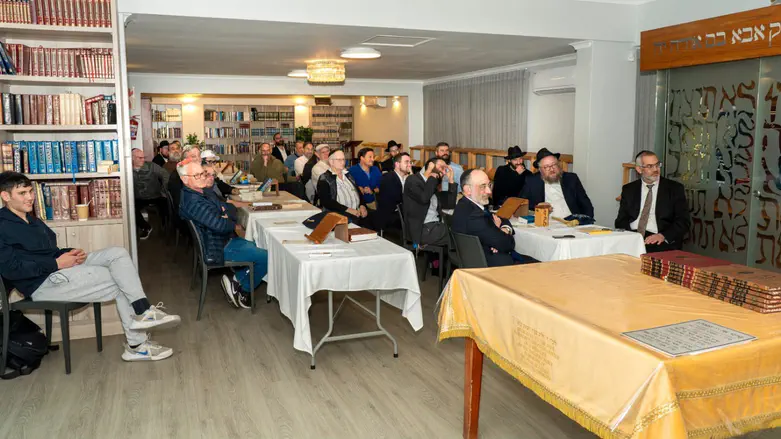
The successful Israeli model of “Tiferet Zkenim” crossed the continent and inaugurated a new “morning kollel” (morning yeshiva) this week in the Blouberg neighborhood of Cape Town, aiming to combat loneliness among retirees.
The Chief Rabbi of South Africa participated in the launch event and blessed the initiative, which restores meaning and routine to the lives of the senior generation.
“The transition to retirement is often perceived as the beginning of a peaceful and relaxed period, but for many seniors, it is accompanied by a difficult landing into a social vacuum: the meeting calendar empties out, social connections weaken, and loneliness turns into a silent distress that harms physical and mental health,” explained the Jewish community.
“While welfare organizations search for various solutions, a deep-rooted Jewish model already operating in about 250 locations in Israel took a historic step this week and arrived in South Africa. The ‘Tiferet Zkenim – Levi Yitzchak’ network, initiated by the Bukharian Jewish Congress and following growing demand from the local community, inaugurated a unique morning kollel in the Blouberg neighborhood of Cape Town,” they said.
Unlike ordinary senior clubs or random lectures, the model is based on daily commitment and a sense of mission: Participants arrive every morning, study together with a “chavruta” (study partner), listen to a Torah class, and enjoy shared coffee in a fixed group. This creates a real reason for them to wake up in the morning, alongside a social circle waiting for them.
The activity in the new kollel is led by Rabbi Oshi Deren, and the daily classes are delivered by Rabbi Hillel Borstein. Taking part in the festive opening ceremony was also the Chief Rabbi of South Africa, Rabbi Dr. Warren Goldstein, who reinforced the move and stated: “This is proof that a community can take full responsibility for its older generation.”
“For the local retirees in Cape Town, the beit midrash (study hall – ed.) has become much more than an educational framework – it serves as a stable anchor that restores what retirement took away: a clear daily routine, social life, and a deep sense of belonging,” they conclude.
Source link