


The Roman poet Ovid had a surprisingly modern approach to sex. In his instructional guide for the ambitious lover, Ars Amatoria (“The Art of Love”), he explored seduction and pleasure. His advice was particularly novel in a society where female sexual pleasure was often treated as secondary, if not entirely irrelevant.
While medical writers like Galen proposed that female arousal could help a woman to conceive, Greek and Roman culture viewed female sexuality with deep suspicion, often portraying it as a disruptive force capable of undermining social order. Since female desire was dangerous, it had to be strictly controlled. Women were groomed for the role of housewives and mothers but not for the role of lovers. “Free rein” between the sheets represented a potential act of defiance, an assertion of autonomy that might threaten to extend beyond the private sphere into other aspects of married life.
A well-behaved woman was not supposed to grab her husband by the balls, metaphorically and literally. Based on that reasoning, a woman’s sexual duty was often reduced to passivity. Desire was politely downgraded to duty, and passion filed under unnecessary extras. A good wife was to act decent and not like a “whore.”
One result was that some men purchased what they did not get from their wives, making prostitution an acceptable and licit way to exercise their sexual urges without committing legal adultery. Prostitutes tempted their clients with nudity, a wide range of sexual positions, and often initiated sex.

Know thyself
It is against this highly “prudish” backdrop that Ovid published three erotic manuals in the year 1 B.C.E. to the year 2 C.E., offering advice that was revolutionary for its time. Addressing male readership in Book 2, Ovid rejects self-serving encounters, writing bluntly: “I hate intercourse that does not exhaust both partners.”
Using the metaphor of a horse race, he urged lovers not to rush headlong toward the finish line and leave their partner behind. Ovid recognized that good sex required considerable effort, referring to it as a form of craft, which ought to be studied and learned. He encouraged his male readers to regard female pleasure as equally important, and approach female desires with curiosity and an open mind. In his poem, he instructs men to pace themselves and watch their partner’s physical responses, with the ideal goal of climaxing together, declaring that the experience should be equally pleasing to both parties: “Do not hurry to the end… fill out the journey with slow delay. When you find the places that delight a woman, let no shame hold back your hand.”
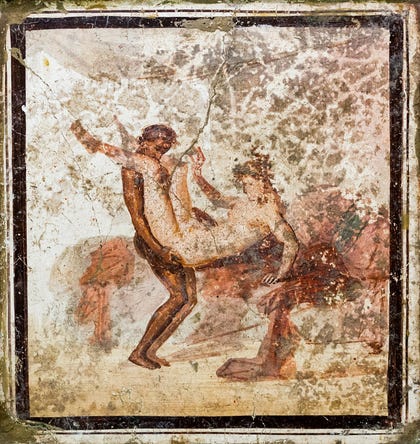
The poet also offers some of the most practical, individualized physical advice in ancient literature. Rather than adhering to rigid formulas, he encourages both men and women to experiment with different positions and angles. While most ancient authors prescribed a single ideal position, Ovid reasoned that body proportions and mutual compatibility should dictate the positions and technique. What suits one couple may fail another.
Physical intimacy, he argues, must therefore be tailored. Lovers should be aware of their bodies and those of their partners to maximize shared pleasure, for there is no one-size-fits-all sexual script. “Let each woman know herself: choose positions suited to her body; one position does not suit everyone.”
While Ovid’s rationale for pairing body types with specific positions was a bit flimsy, his underlying reasoning was nevertheless progressive, for he refused to reduce sex to a rigid hierarchy. The sexual menu advanced by most other male authors, by contrast, was the reproduction of the established social order, with men occupying the active, dominant role and women relegated to passivity. This physical arrangement mirrored women’s subordinate status within Greco-Roman society.
Ovid, by contrast, makes sexual technique responsive to the individual woman (either for her own satisfaction or the desire to please the partner). Her body, preferences, and pleasure become considerations in their own right, rather than mere extensions of male desire.
His insistence that a woman should know her own body thus carries significance beyond practical sexual advice: it acknowledges her as an individual with particular needs and desires. Where men shaped their identity through public engagements, women were defined through the prism of being wives and mothers. In a society where women had little liberty, sexuality offered a medium of expression (despite often ending in pregnancy); consciously or unconsciously, they were assuming some control.
Ultimately, the message was quite straightforward: know thyself, pay attention to your partner, and remember: practice holds the keys to sexual harmony and satisfaction.
Ovid also emphasizes that a sexually satisfied partner is far more likely to remain loyal and overlook the other partner’s flaws. As the writer observed, sexual intimacy plays a significant role in keeping long-term marriages resilient. The ultimate goal is to cultivate a relationship where two people flourish in each other’s company, both inside and outside the bedroom. Attention and affection are timeless aphrodisiacs.

The art of faking
The “handbook” also carries a political edge. Written during Augustus’ moral campaign to enforce strict marital laws and restore traditional Roman family values, Ovid treats romance as a playful game rather than a sober civic duty. He does not fail to mention the theatrical part of sex. When he addresses women in Book 3, he not only advises them to dress their best and apply makeup to enhance their natural beauty without distorting reality, but also gives frank advice: fake pleasure.
“Let seductive words and sweet murmurs never cease. Let no passionate words fall silent amid your lovemaking (…) feign joy and take pleasure with pleasing sounds,” writes the poet.
Faking sexual satisfaction is portrayed as an essential grooming ritual, no different from applying makeup or styling hair. For the poet, maintaining the illusion of erotic fulfillment is critical to preserving intimacy and nurturing a relationship. Ovid puts it bluntly: male confidence can be extremely fragile. If the woman appears bored and unsatisfied, the man feels inadequate.
The premise was simple: when natural passion fades, or a partner’s performance declines, simulated fondness preserves the illusion of fireworks. Putting on a show becomes a form of social courtesy: a performance designed to spare a man’s pride, sustain or boost his confidence, and keep the intimacy alive (for better or worse).
The queen of erotica
Social courtesy of “faking it” was probably not to everyone’s taste, and some writers skipped the etiquette of seduction and went straight to the practical side of the business. The undisputed queen of this straightforward approach was Elephantis, a celebrated figure in classical erotica, who eventually faded into the mists of history.
In truth, we know almost nothing about her. We cannot even confirm she existed. Her very name was a pseudonym, a common branding strategy among high-class courtesans (hetairai) in ancient Greece who favored provocative, animal-derived names. A calculated marketing ploy? Quite possibly. After all, who could resist a masterclass from a woman whose very name promised a wild ride?
Her manuals detailing positions and physical techniques did not survive antiquity, but references from Suetonius, Martial, and Tatian suggest that among the Roman elite, Elephantis was a best-selling author. For instance, the Roman biographer Suetonius reports that the Emperor Tiberius kept a complete collection of Elephantis’s erotic manuals in his villa at Capri: “He decorated bedrooms arranged in various places with paintings and statuettes depicting the most lascivious images and figures, and furnished them with the books of Elephantis, so that no one would lack an example of the prescribed position when performing the sexual act.” After all, education first.
Her reputation extended beyond the erotic world. Pliny the Elder cited her expertise as a midwife, while the physician Galen credited her with remedies for treating hair loss (some anxieties are timeless). Scholars suspect that the name may have been shared by both a writer and a physician, whose identities blurred together over time.
If one trusts ancient sources, the woman behind the exotic name urged her readers to cast off social inhibitions, and embrace physical variety through all kinds of naughty positions. Her supposed philosophy feels contemporary: reject routine, for novelty is the lifeblood of desire.
Where Elephantis reportedly approached erotic pleasure through experimentation, Sappho examined it through the language of sensation and longing. For the Greek poet, sexual attraction was more than a physical appetite; it required affection, mutual admiration, and a deep emotional connection. Her poetry places emotional intimacy at its heart. Good sex requires more than the right mechanics and anatomical alignment.
This desire beyond physicality is echoed in classical Greek philosophy. Plato’s Symposium presents physical attraction as merely a starting point. While beauty often triggers initial desire, emotional and intellectual intimacy feeds the flame.
Keep it real
And then there is good old Martial, the Roman master of the epigram, who brings us back down to earth with a slightly irreverent contribution. Unlike his fellow poet, Ovid, he was not particularly interested in offering a systematic guide to seduction, nor did he approach erotic pleasure with Sappho’s sensitivity or Elephantis’s technical dedication and curiosity. His specialty was human nature, especially its absurdity, and sex did not escape his penetrating gaze.
For Martial, sex was chaotic, messy, and deeply flawed, just like the people engaging in it. He mocked performative pleasure, theatrical moans, and manufactured displays of passion. In one particularly playful epigram, the poet mocks a woman named Aegle, whose singing dramatically improved once she “embraced” celibacy. “Aegle, when you were fucked you sang badly. Now you sing fine, though never to be kissed,” he writes.
Martial takes the satire even further in a later epigram, turning an elderly husband’s physical limitations into a domestic farce: “Leda tells her aged spouse she suffers from nerves, and cries that she absolutely has to be fucked; but, with tears and moans, sighs nothing is worth that, and declares she’s reconciled to dying instead. He begs her, live, not lose her years of youth, and lets be done what he can’t do now himself. The female doctors leave, males take their place, her knees are raised. O weighty remedy!”
Martial was a wholesome dose of vulgarity that offered a refreshing counterweight to ancient erotic idealism: the reminder that sex is rarely a flawless performance, and that taking oneself too seriously is the best way to ruin the mood. His message, if one can call it that, was simple: keep it real.