The selection of Matan Kahana as Knesset speaker pushed through by Arab votes makes it abundantly clear that the Arabs now control the levers of power in Israel. They can make or break governments, politicians, and policies. They have a stranglehold on the left which cannot survive without them. They exploit our democracy and expose its greatest weakness.
As Henry Kissinger famously put it, “power is the ultimate aphrodisiac.” That the Arab parties now have the power, and what others will do to claim titular power, is humiliating to the Jewish state of Israel and dangerous as well.
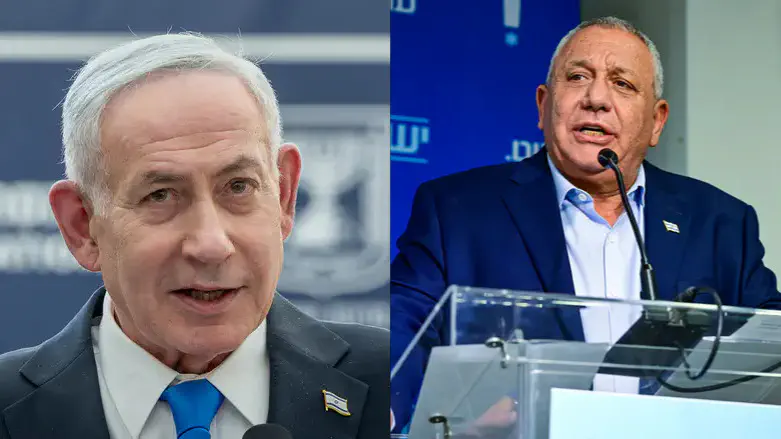
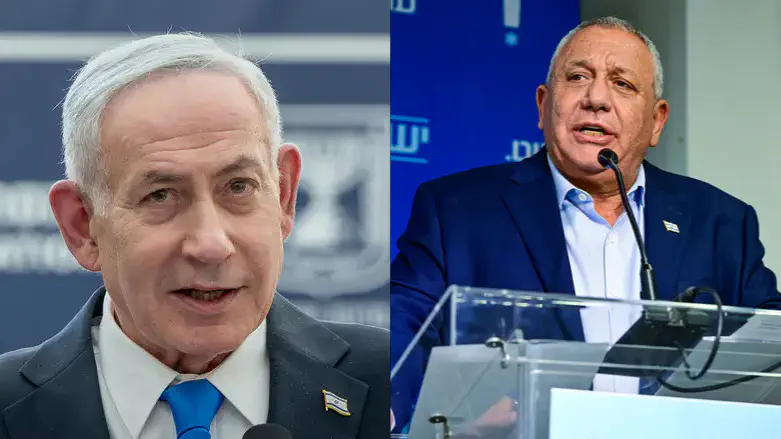
As such, it seems that the likeliest outcome of the attempt by Gadi Eisenkot’s Yashar Party to assemble a coalition will be a minority government that is hostage to the nineteen votes of the Arab parties, which refuse to label Hamas a terrorist group and serve essentially as a fifth column within Israel. This would explain why there is no sense of urgency to form a government; a minority government is a given. Other parties could be added to that formation. Everyone is acting, playing their role in a game whose result is already known.
Many people sincerely dream of a national unity government involving Likud and Yashar and a handful of other Zionist parties. From one perspective, in theory, a unity government could make progress on a number of important issues without having to deal with extremes, as well as confront the ongoing security threats facing Israel on multiple fronts.
But from another perspective, well, everyone loves “unity,” but policies do matter. What if the two main parties disagree on critical issues? PM Netanyahu staked his career on preventing the development of an Iranian nuclear weapon that could destroy us; Eisnekot said years ago that he is willing to concede an Iranian bomb. What is the middle ground?
Does Eisenkot have an economic policy? Tax policy? Educational policy? Likud represents the more traditional Israel, Eisenkot the more secular Israel. Is there a middle ground on issues of religion and state, beyond maintaining the status quo that elements of the left want to undo? Could such a government label Qatar and Turkey enemy states and halt their funding of Arab organizations that seek to undermine our sovereignty in Jerusalem and elsewhere, not to mention our elections? How would such a government choose the next batch of Supreme Court justices, who control our politics more than does the Knesset, or the next Attorney-General, which is akin to appointing our next dictator?
Unity is a fantasy and maybe a necessary one but it is also a recipe for paralysis. Yet that is not even the main reason a unity government is unlikely. The main reason is that the foremost concern on the left from the beginning of the campaign and even going back well over a decade is simply to get rid of Netanyahu. That is it. Any platform they proffered was just a side show to the main act: Bibi must go! If that is the case, a unity government that retains Netanyahu completely undercuts the principal promise the left made to its voters.
Note that the left (Eisenkot, Liberman, Bennett) repeatedly, loudly, and explicitly guaranteed to its voters that any government under their leadership would not rely on Arab votes for its existence. Maybe they believed it, maybe they intended it, maybe they were lying even then; the bottom line is that most of their voters simply do not care about that promise if they succeed in their core objective: getting rid of Netanyahu.
It is a mistake for the right wing to harp on the fact that the Knesset, its committee chairs, and the future government hinges on the votes of Arab parties who support terror against Jews. It sounds good, and certainly the sensitivities of the bereaved families, wounded soldiers, and stalwart reservists, horrified by this prospect, warrant validation – but the bigger problem is that this should have been foreseen, and violations of the law prosecuted.
The credible reports of widespread cheating in the Arab sector in the recent election, and the quashing of any investigation, are more ominous. There is an even bigger issue. Today the Arabs in Knesset have 19 seats. What if they win 25 in the next election? And 35 in the one after that? If cheating works – ballot stuffing, bribery, fabrication of votes – then of course they will continue to do it, until they have the sufficient mandates to vote the Jewish state of Israel out of existence. What will the Knesset do to stop that – and what can they do if the Attorney-General and Supreme Court would overturn whatever the Knesset did?
It is hypocritical, albeit understandable, that the sane Zionist parties recoil from a Knesset or a government controlled by hostile Arabs because the real problem is a Supreme Court that refuses to enforce the election law that bans parties that reject Israel as a Jewish state and a democracy.
The current Arab parties openly reject the notion of Israel as a Jewish state and thus have recurrently been banned from running by the Central Elections Committee (even in the most recent elections!) only to be restored to the ballot by our rogue, lawless Supreme Court.
Certainly, Arabs supportive of Israel as a Jewish state in which their minority rights are protected, who denounce terror and do not consort with our enemies, should be allowed and encouraged to run. But we have granted our enemies access to our inner sanctum, distorted our laws to enable them, and they have taken full advantage of it.
If a minority government backed by Arabs is the likeliest scenario, then why doesn’t Eisenkot just announce it today? Because he prefers the fig leaf of haredi parties that can give him a “Jewish” majority of 61. And he knows that if down the road haredim leave his government for one reason or another – which is bound to happen – he will still have the security blanket provided for him by the Arabs.
That is why he and his partners, in defiance of yet another solemn pledge to their voters, are offering the haredim exemptions from IDF service, exemptions whose scope and number exceed anything that has been proposed in recent years.
And yes – all those voters who sincerely wanted an equal sharing of the burden, and who resented the haredi exemption, and who punished the Religious Zionist party and Likud at the polls for their failure to conscript the Bnai Yeshivot, all those voters were played for fools, manipulated by a sophisticated and well-funded (mainly from overseas) campaign by cynical politicians.
Suddenly, we are learning that even Avigdor Liberman no longer believes that everyone must serve and only those who “serve, receive 100%; those who don’t, receive 0%.” Never mind! Suddenly, we are learning that the IDF really doesn’t need more soldiers (except to the extent that every general always wants more soldiers) and intends next year to reduce its manpower and shrink its enlistment. My, how things changed overnight.
The controversy was always mostly political, which doesn’t excuse the haredi and Yeshivish world from their Torah obligations to the common weal and defense. The question is will they accept the offer? Is the offer even sincere? Will they be hooked into a government some of whose members are openly antagonistic to Israel as a Jewish state and the application of halakha in any area of life? Will they agree to promises of exemptions that the Supreme Court might (should, based on prior rulings) then reject? Will they give the hekhsher (seal of approval) to a government that depends on the support of those inimical to our existence and whose policies will weaken our claim to the land of Israel and the observance of the Torah?
If they do, it is shameful, a classic application of the rabbinic dictum that “aveira goreret aveira,” one sin leads to another (Avot 4:2). The sin of spurning the defense of the people and the land of Israel – two fundamental mitzvot – will have engendered the sin of underwriting those who favor dismantling the Jewishness of the state, Shabbat, Kashrut, conversion, marriage and divorce, etc. as well as those who want to eradicate the state itself.
On the other hand, if they don’t, well, then they get nothing – no exemptions, no money, and probably an upward ratcheting of arrests and incarcerations, as well as brutality against protesters and demonstrators.
It is a conundrum that has boxed in Yahadut Hatorah (UTJ). Decline, and get nothing, or join and get something but sell your principles for a temporary and illusory advantage. And the temptation would then be great for Shas to also join the government, which would then have 61 seats without the Arabs, and share in the spoils – but at what price to Torah, the real, living Torah?
The tacit reliance on Arab support can explain why Naftali Bennett has been so silent (until today) and why Avigdor Liberman has been so accommodating to the haredim whose infamy and malignity he proclaimed for decades. Obviously, to be part of a minority Jewish government wholly reliant on radical Arab support violates yet another of their campaign promises, but so what? Worse, it will cripple our ability to fight terror, settle the land of Israel, and arrest the illegal Arab encroachment and building in the Galil and the Negev.
We will also have – like much of the West already has – fallen prey to the Muslim Brotherhood guide to the global Islamic revolution: take control of societies from the ground up and then slowly infiltrating their governments, until domination.
A minority Jewish government will facilitate that takeover rather than hinder it.
All this is likely but not inevitable.
What can be done to avoid this predicament?
As I see it, there is only one scenario, which might be even less likely to occur although it would solve many issues: PM Netanyahu should offer to step down and the Likud should appoint a successor who would be able to form a government.
Let’s face it. Binyamin Netanyahu has been a most consequential leader of Israel, a world class diplomatic force, and a thought leader. He has many successes to his credit – as well as many failures, primarily among them (not October 7, which would have happened on the watch of any Israeli leader) his utter failure to rein in the unlawful excesses of Israel’s legal and judicial establishments. Sure, he has been the number one target of their corruption, and the bogus cases against him – meant, by their own telling, to drive him out of public life – should never have been brought and should be dismissed forthwith. But he let that problem metastasize, and it has both neutered and consumed him.
In truth, perhaps Israel’s political universe has revolved around him for too long, and he is palpably polarizing. There are many people who adore him but many people who despise him. In his second long tenure as prime minister, he first led the Likud to 28 seats in 2009 – and now to 27 seats in 2026, more than Eisenkot. His base seems fixed, as are his antagonists. He gets an increasing number of votes – almost 1.2 million in this election, an increase of 25,000 and more than 250,000 than the next largest party, but that is not enough the way Israel’s government works.
Most of the opposition is the opposition to him, personally. Most, if not all of these political leaders, are people he appointed to public life – ministers, generals, aides, etc. They loathe him and refuse to collaborate with him or form any government that includes him. It doesn’t matter why or whether it is justified; what matters is that this hatred has become toxic for Israeli society.
To be sure, it would be a great loss for Israel – in terms of our relationship with Donald Trump (who has his own problems these days, bigly) and in the presentation of Israel’s case on the world stage (not that we are so popular in the world). Netanyahu has been an incomparable exponent of Israel’s values and policies and it is hard to imagine who can replace that. But he will be replaced, for no person is indispensable, and his departure will remove the main obstacle – fair or not – to a stable, Jewish government.
If the choice is between an Eisenkot minority-Jewish government beholden to Arabs and a Likud-led government without Netanyahu, then the latter is preferable for a host of reasons. He would retire with dignity and have the gratitude of most of the nation that he served honorably, if imperfectly. That it probably won’t happen is not to say that it shouldn’t happen. It should – but Jews who are “a wise and understanding people” (Devarim 4:6) have not always been known for our common sense or our good decisions.
But “this great nation” (ibid) deserves better and the Jewish state that depends on Arabs for its survival will not be Jewish or a state for long.
Or I could be completely wrong.
The situation is fluid, unpredictable, and the path to any government is serpentine. One can hope that the two leading parties will exhibit maturity and national responsibility and form a broad unity government that includes four or five or six other parties, a government that will focus on our external threats and leave philosophical and constitutional disputes for some time in the future. Or there can be new elections. The choice is theirs. And ours.
Rabbi Steven Pruzansky, Esq. is aTorah lecturer in Modiin, serves as the Senior Research Associate at the Jerusalem Center for Applied Policy (JCAP.ngo), Israel Region Vice President at the Coalition for Jewish Values, and is the author of six books, including “The Jewish Ethic of Personal Responsibility” (Gefen Publishing).
Source link