


Where modern culture relies on social media feeds and comment threads to communicate, the Romans turned to their architecture. The plastered walls of Roman cities served as an open-access billboard for public commentary, carrying everything from political slogans and advertisements to declarations of affection, poems, jokes, obscenities, and, inevitably, personal attacks.

Although the graffiti did not usually descend to private intimate images, nor was every sexual insult an act of revenge, these ephemeral inscriptions reveal a persistent feature of human behavior: the deliberate use of sexual information, or sexual allegations, to shame another person before a public audience.
A wall of shame
In some respects, the similarity to social media is striking. “Tagging” names on city walls resembles today’s social media realities. While these ephemeral inscriptions lacked the digital infrastructure of today’s platforms, they illustrate a persistent psychological reality: using sexual allegations to inflict public humiliation. With a bit of charcoal or a sharp stone, anyone could insult an enemy or expose a former lover’s alleged transgressions.
Much like a digital post today, an ancient comment in a high-traffic area reached an audience far beyond the creator’s immediate circle. To make matters worse, the readers often added their own observations below the original text, turning a single act of venom into a collective exchange that reads remarkably like an online comment section.
Of course, these inscriptions lacked the speed, extent, or reproducibility of digital communication. An accusation on a wall could not reach thousands of people within seconds or be replicated across multiple platforms with a click, leaving a long-term footprint. Nevertheless, its public visibility created a similar containment problem: once an accusation entered the public domain, its target could not know who encountered it or whether it would be repeated. Even if an inscription was later concealed, the damage was done, for the content’s disappearance rarely means the end of its social consequences.
The humiliation arose not merely from being insulted, but from becoming the object of collective laughter. In this sense, Roman graffiti’s significance lay not in the insult itself, but in the conditions of its exposure. In the tightly interconnected world of Roman public life, the existimatio, or reputation, was everything. It was a currency that dictated legal rights, eligibility for public office, and even financial creditworthiness. To dismantle a citizen’s sexual standing was to strike not only at their civic identity but also potentially at their livelihood.
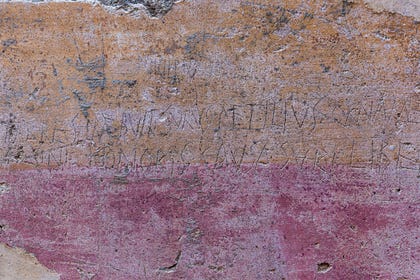
Albanus is a perv
The surviving graffiti of Pompeii and Herculaneum reveal how sexual insults could turn a wall into a public forum of humiliation. Some inscriptions mocked alleged sexual behaviors, while others used crude sexual labels to ridicule men and women, making them objects of public mockery.
These attacks were not necessarily based on personal knowledge; they might have been fabricated. Some may have been regarded as jokes, provocations, or were just the product of a bored mind. Yet even if written in jest, such insults drew on cultural assumptions about sex, and the strict social expectations that were attributed to gender. Their existence points to a universal urge that continues to this day: the need to humiliate others using vocabulary that thrives to this day in locker rooms, restrooms, and other public spaces where anonymity invites vulgarity.
The aim is not simply to accuse a man of sexual misconduct, but to portray him as sexually deviant, effeminate, and fundamentally unworthy of respect. One such accusation was immortalized on a public building in Pompeii: “Gaius Valerius Venustus, a soldier of the 1st cohort, was here. He is a cinaedus and sucks dicks”.
The term cinaedus, used to mock men who engaged in passive homosexual acts, was particularly offensive. The same logic of dominance and degradation extended beyond penetration to other sexual acts, particularly oral sex. Another inscription near a street corner of the ancient city reads: “Theophilus, don’t perform oral sex against the city wall like a dog.”
For the Romans, performing fellatio or cunnilingus was seen as an act of submission and lacked dignity, especially for a man. In the Greco-Roman world, the mouth carried significance that extended well beyond the bedroom. It wasn’t just a body part reserved for speech, prayers, eating, and breathing: it also carried profound philosophical and moral symbolism. Hence, spoiling it with a sexual organ was seen as deeply degrading, especially when fluids were involved.
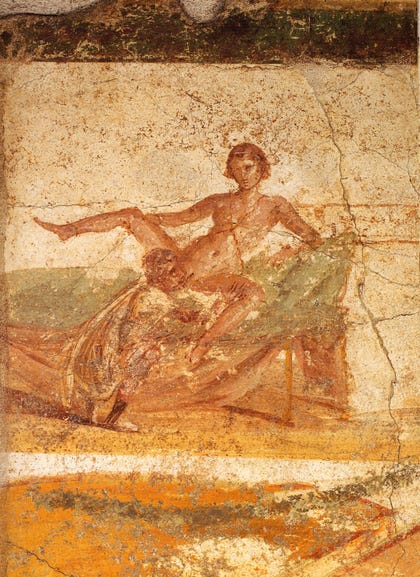
Also, the act of going down on one’s “knees” was not to everyone’s taste, for the posture was associated with a servile spirit. Sexual insults thus drew their force not simply from the acts themselves but from the broader cultural meanings attached to bodily position, status, and gender.
Other examples of graffiti from Pompeii tell a similar story. An inscription found in different locations throughout Pompeii labels a certain Albanus a pervert; another inscription on the exterior of the city’s amphitheater directs a similar insult at a man named M. Titinius, calling him a deviant. While the wording might sound mild to modern ears compared to the broader range of available profanity, their force lay in what they implied about the men to whom they were attached: masculinity meant dominance and control and the insults implied they didn’t have it.
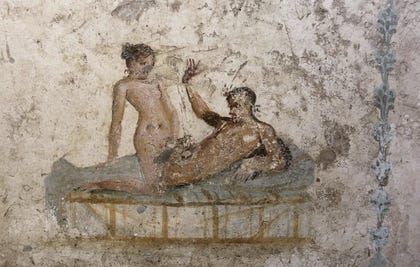
In the Roman imagination, the bedroom was inseparable from public life, and so it all came down to two things: active vs. passive. Penetration was synonymous with authority, while being penetrated carried the stigma of the “weaker sex” and slaves. Inviting entry by taking the passive role was seen as the height of unmanliness. To willingly relinquish the active role was more than a matter of personal preference; it was seen as a failure to embody the virtus (manliness and civic virtue) that distinguished a respectable citizen from those Roman society deemed barbarian.
Of course, it doesn’t mean every Roman accepted these ideals, or that every insult produced lasting consequences. The graffiti rarely tell us how the targets of the inscriptions reacted or how seriously their audiences took them. Their significance lies instead in the shared cultural vocabulary in which sexual submission was synonymous with social inferiority.
Below the belt
In the higher tiers of Roman hierarchy, sexual shaming became a calculated political weapon. Roman orators routinely attacked their rivals’ private lives to undermine their public credibility. Allegations involving adultery, sexual misconduct, incest, effeminacy, and other forms of sexual deviance could become part of a broader campaign to destroy someone’s dignitas. It was a below-the-belt tactic that abandoned substantive political debate in favor of personal humiliation, but it worked.
Of course, the accusations did not necessarily need to be true to be effective, but they needed to be “memorable”, needed to fit an existing social prejudice, and above all, needed to attach themselves to a person’s identity. The objective was to create a story people would “buy” and repeat.
Cicero was particularly skilled at this. In his “Philippics”, he portrayed Mark Antony as morally corrupt and sexually deviant. Antony was accused of “un-Roman” conduct, meaning youthful prostitution and passive homosexual acts for political gains. The Roman statesman delivered a series of public speeches claiming that, as a young man, Antony had acted as a male prostitute for the famous politician Gaius Curio: “You took the adult toga, which you immediately turned into a prostitute’s gown. At first, you were a common whore, with a fixed price for your shameful favors… then Curio took you into a lasting marriage, as if he had given you a veil.”
Julius Caesar faced similar attacks. The above, Gaius Scribonius Curio, referred to Julius Caesar as “every woman’s man and every man’s woman” in one of his speeches. Preserved by the historian Suetonius, the phrase compressed a much broader sexual reputation into a single, memorable insult: Caesar was portrayed as the lover of women and the sexual subordinate of men.
We do not know the precise occasion for Curio’s speech, or whether Caesar was present, but the allegation followed Caesar throughout his political career. His enemies also repeatedly circulated rumors about his relationship with Nicomedes IV, king of Bithynia, during his youth, earning him the mocking nickname “the queen of Bithynia.” Whether true or not, the rumor became a persistent way to ridicule one of Rome’s most powerful men. Even his military victories could not silence the whispers.
For women, sexual accusations carried a different kind of weight. Just as modern revenge porn and non-consensual image sharing disproportionately target women to inflict moral judgment, Roman society vigorously weaponized accusations of female promiscuity.
Since a woman’s chastity was inseparable from her family’s honor and the legitimacy of its heirs, allegations of sexual misconduct could have catastrophic consequences for the entire household.
Even poets were not above shaming women. The poet Catullus famously used explicit verse to air intimate details and settle personal frustration against his former lover, Clodia Metelli. Following the bitter end of their affair, he publicly targeted the once cherished in his poetry, accusing her of engaging in casual sexual encounters in the back alleys of Rome.
Similarly, the elegiac poet Propertius weaponized verse against his former lover, Cynthia. After she rejected him, he decided to punish her by exposing her secret affairs, accusing her of nightly promiscuity, and broadcasting her private habits to his readers.
In “The Art of Love”, Ovid documented a common form of post-breakup retaliation among men: public defamation. Rejected lovers frequently fabricated lies about their sexual behavior, boasted about intimate details, and spread malicious gossip within local taverns. For these men, as Ovid noted, the objective was clear: if they could no longer be with the woman, they would ensure her social standing and marriage prospects were destroyed.
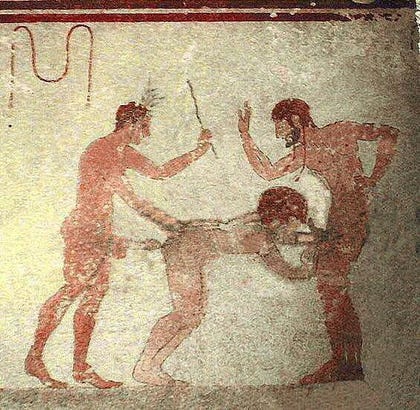
Emperors and senators alike transformed accusations of female adultery into public spectacles of state-enforced shame. When women were described engaging in sexual acts, adopting supposedly shameful positions, or displaying excessive sexual desire, the details were often less important than the message the story was designed to convey. The historian Tacitus, for example, portrayed Messalina, the wife of Emperor Claudius, as the embodiment of uncontrollable female lust. In his “Annals”, the historian recounts the sensational story of the empress who enjoyed going blonde when sneaking out at night to Rome’s red-light district. Not only did she frequent brothels to offer her royal services, but she also competed with a very motivated prostitute in a sexual marathon that lasted all night. The empress came out on top with a score of 150 men, officially “endorsing” prostitution.
It’s impossible to establish whether any of the stories were true. What matters is how effectively it reduced a politically influential imperial woman to a prostitute.
The list of dirty women goes on. Accusations of adultery and sexual excess became recurring features of Roman political life, particularly when powerful families were involved.
Whether through graffiti, political speeches, or poetic verses, the Romans became exceptionally good at weaponizing sexuality. In the end, the means have changed, but the appetite for turning private intimacy into public ruin endures.