
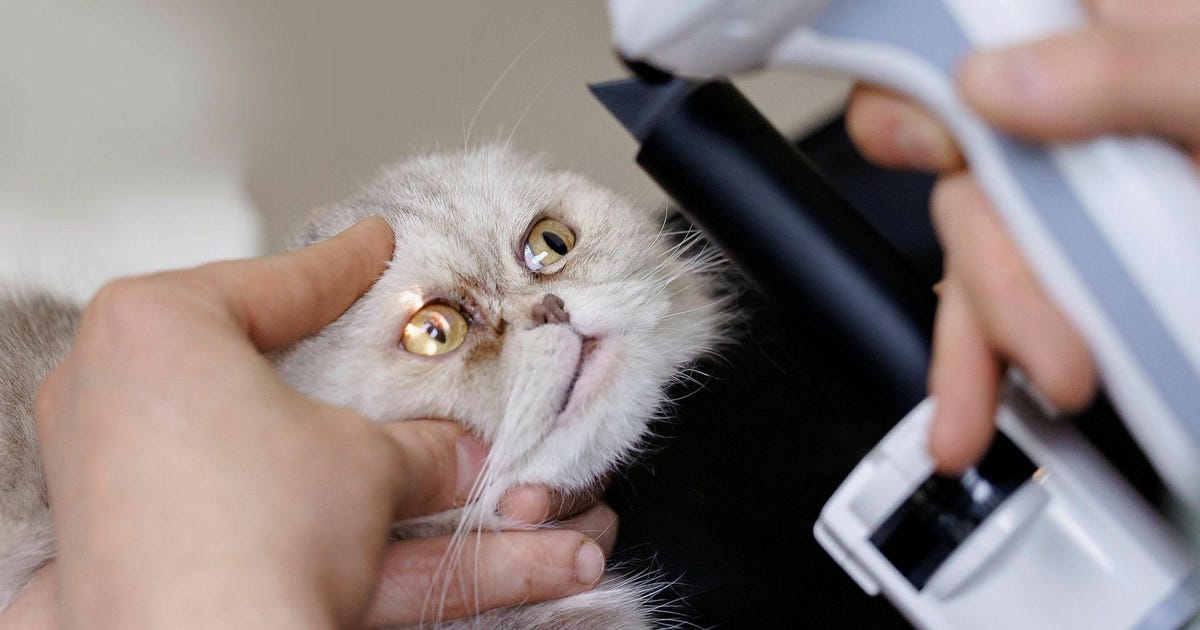
Drug-resistant diseases are an exploding problem worldwide and not just for humans. Our pets are affected too, and a new paper warns that drug-resistant eye infections are becoming an increasingly important threat to vision in dogs, cats and horses.
The review of animal eye infections was published in Veterinary Ophthalmology by researchers Dr. Lionel Sebbag and Dr. Oren Pe’er from the Hebrew University of Jerusalem, at the Koret School of Veterinary Medicine. While data were unavailable from some regions, particularly Africa, the overall pattern suggests that drug resistance in ocular pathogens is a global concern.
Dogs and cats are popular pets but horses are not. Why were they included in the review and did the two look into other hoofed quadrupeds?
They included horses because there is a critical mass of ophthalmology and antimicrobial resistance data on them and also, Sebbag points out that horses are “very common” in Israel, as “pets” for sport, for example. The review doesn’t encompass other species such as donkeys or zebras because the data just isn’t there, Sebbag explains.
In animals, microbial resistance is caused by misuse of drugs and let us be clear that this is a plague everywhere from human hospitals to veterinary clinics to agriculture. Yes, crops are affected too. The problem is becoming so prevalent that scientists warn of a post-antibiotic era that will look like the pre-antibiotic era: we will have nothing with which to treat bacterial infection. Back to thoughts and prayers.

When Bob died
The problem of resistance begins with the fast reproduction rate in bacteria, and hence their fast natural mutation rate. Microscopic creatures can reproduce very fast. (All this applies to pathogenic fungi too.)
Take the dear creature Vibrio natriegens, which lives in salt marshes. Given good conditions this organism can duplicate every ten minutes, making it the fastest-reproducing life form we know. Theoretically the new bacteria is a clone of the original and so genetically identical. But actually, with every duplication, mistakes happen. Genomic imperfections are mutations and in bacteria, some mutations confer resistance.
Say we have ordinary Bacterium Bob. One day Bob splits into Bob and Sam. Then somebody administers an antibiotic. Bob dies! But Sam was not a perfect copy of Bob and his mutation enables him to survive that antibiotic. Sam then happily splits into Sam and Steve, who are both resistant and procreate madly.
What have we? An animal with an adapted population of bacteria and a doctor scrabbling for another drug to treat the infection, which can lead to “multi-drug resistance.”
That is in a nutshell how we can get “superbugs” – strains of bacteria or fungi that fewer and fewer drugs can kill.

Let us be clear that resistance is a natural process of adaptation, going back to the dawn of bacteria billions of years ago. When early bacteria infected other early creatures, natural substances to fight the bacteria also emerged. All we are experiencing now in our clinics, hospitals and living rooms is a natural process on speed because we are flooding our bodies, ourselves and our farms and environments with antimicrobials, creating gorgeous conditions for superbugs to emerge and breed.
It is not natural to dose a pond where one grows fish, or all the cows and chickens in a farm, with prophylactic antibiotics in order to stymie disease. It is a short-term fix at best – whatever else we achieve, we have created an environment that selects for bacteria able to overcome the drug. We just note that a warming world is by and large a better one for bacteria. Rising temperatures accelerate their reproduction which just boosts the potential for antibiotic resistance.
Beyond prophylactic abuse, drug misuse is everywhere: doctors prescribing unnecessary antibiotics, patients failing to complete the antibiotic course and leaving some bugs maybe feeling queasy but very much alive, cats who spit out the medicine, and the less said about what dogs eat the better – the upshot is that we create an environment of natural selection where weak bacteria die and the strong survive.

Look Fido in the eyes
The review identified three bacterial groups that consistently emerged as important causes of eye infection in dogs, cats and horses: Staphylococcus pseudintermedius, beta-hemolytic streptococci, and Pseudomonas aeruginosa. Yes, animals can have these anywhere in or on the body but this paper is about their eyes.
One of the most consistent findings across the studies related to previous antibiotic use: Across multiple studies, recent exposure to topical antibiotics was consistently associated with a greater likelihood of isolating resistant bacteria from the animal. That is exactly in keeping with the theory.

Which are the three most common bacteria in our pets’ ophthalmological secretions? One is Staphylococcus pseudintermedius, a bacteria that can cause a host of troubles beyond the eyes: ear infections, pyoderma (think cellulitis) and “swimmer’s ear,” as well as systemic internal infections. Two is beta-hemolytic streptococci that causes strep throat in humans, and serious infection in immune-compromised or unlucky pets. Three is Pseudomonas aeruginosa, a normal denizen of soil and water, that can cause horrible conditions in pets and people (or who just don’t clean their contact lenses properly).
How likely are we to catch a condition from Sparky or Mittens? Horse sense is key here.
“In general, the risk of transmission between pets and owners is low. It can happen in either direction, but usually requires close contact and/or complicating factors such as poor hygiene, immunosuppression, or pre-existing eye disease (for example, dry eye) in the person or animal,” Sebbag answers. But if Fido has a resistant infection in his eye and you catch it, then yes, you will likely have the same strain, he confirms.
Resistance is a property of the bacterium, not the host. “Fortunately, transmission appears to be relatively uncommon,” he sums up.

Of course, that assumes one behaves rationally. Asked for advice beyond washing one’s hands, Sebbag lists: Avoid direct contact with Fifi’s eye discharge and don’t share towels or pillows with an animal suffering from an active infection. And of course, wash your hands after applying medication, assuming the animal lets you apply the medication.

Which brings us full circle to completing the course of antibiotics. Severe corneal infections (bacterial keratitis) caused by these organisms can progress rapidly and may threaten vision in the poor pet or horse within hours to days if left untreated.
This sounds bewildering. Over-use of antibiotics causes trouble and doctors may not be cautious enough, so what is one to do when Fifi is blinking strangely? Should we wait before consulting?
Sebbag’s practical advice is that if beloved’s eye is red, seems painful, if Sweetums is squinting or has discharge – don’t wait long: 24 to 48 hours at most before consulting a doctor. These things can progress fast. “Early examination actually helps reduce unnecessary antibiotic use, because not all eye issues are infections,” he adds.
Whatever you do, don’t use leftover medicines at home. A lot of people do that and it’s “very problematic,” he adds.
Are these conditions rarer in housecats that don’t leave the house? No, sadly, they are just as common in indoor-only cats, Sebbag says. “Most are normal bacteria that naturally live on the eyelids and eye surface, not bacteria picked up from the environment. They usually only cause problems when there is a corneal ulcer or scratch that disrupts the eye’s natural barrier.”
What is the bottom line? Appropriate antibiotic use remains essential for treating infections, so the goal is not to avoid antibiotics altogether, but rather to use them judiciously and when truly indicated, Sebbag says.
As for co-sleeping with the hairy one, again rationality comes to the fore. “During an active eye infection, especially with discharge, it’s reasonable to pause close face-to-face contact (including sleeping very close),” he advises. “Not panic-level, just common sense hygiene.”