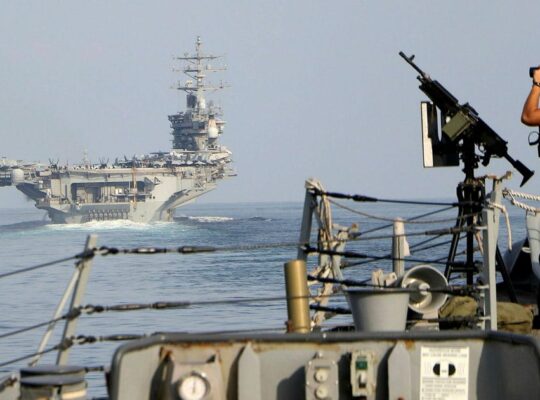

Iran’s leadership warned on Tuesday of the possibility of a preemptive strike against Israel, the country’s newly created Defence Council said in a statement released Tuesday.
Any interference in Iran’s internal affairs or attempts by enemies of the Islamic Republic to undermine the country’s stability would be answered, officials said.
The council, which was set up in August following the 12-day war with Israel, added that Iran would not limit itself to reacting “only after an action has taken place,” but would also regard “concrete signs of threats as part of the security equation.”

Iran’s Revolutionary Guard conducted military drills on Sunday, testing its air defense systems and the readiness level of its missile units. Iran’s threat of a preemptive strike was issued as security forces struggle to contain widespread protests that have erupted due to rising inflation.
The Defence Council said, “Iran’s security, independence and territorial integrity – all of these are red lines that cannot be crossed. Any aggression or continuation of hostile behavior will be met with an appropriate, decisive and severe response.”
The state-run Tehran Times referred to possible “preventive self-defense.”
Prime Minister Benjamin Netanyahu has reportedly informed Tehran via Moscow that Israel is not planning on military escalation. Israel and Iran do not maintain diplomatic relations, and there are no direct channels of communication.
Iran’s Supreme Leader Ali Khamenei posted a statement on X, saying he doesn’t trust Israeli assurances. “What makes the enemy first request a cease-fire … then send messages saying he doesn’t want to fight us? Of course, the malicious enemy is a deceiving liar & we don’t trust them.”
Three senior Iranian officials told The New York Times that senior members of the Islamic Republic’s leadership have admitted in closed-door talks that the regime must prepare to enter survival mode in the wake of the growing protests in the country.

Haaretz Weekly
From tragedy to solidarity: The Jewish world’s turbulent and traumatic 2025
Haaretz Weekly
From tragedy to solidarity: The Jewish world’s turbulent and traumatic 2025
total— : —
According to the New York Times, regime officials appear to have few tools at their disposal to deal with either the worsening economic situation, which is fueling the protests, or the threat of further conflict with Israel and the United States.
Iranian President Masoud Pezeshkian has voiced similar sentiments publicly, at one point declaring that he “has no ideas” on how to solve Iran’s many problems. “Any policy that is unjust is doomed to fail,” Pezeshkian said in a speech on Thursday – his first since protests began. “We must accept the fact that we have an obligation to listen to the people.”
According to the New York Times report, on Friday, after U.S. President Donald Trump all but explicitly threatened to strike Iran if the regime did not stop violently suppressing the protests, the country’s Supreme National Security Council convened an emergency meeting to discuss ways to curb the demonstrations while minimizing use of force, in order to avoid angering the public further. At the same time, council members also sought to prepare for the possibility of military strikes, according to the report’s sources.
Violence surrounding the demonstrations have killed at least 35 people, Human Rights Activists News Agency reported in its latest update on Tuesday.
According to HRANA, 29 protesters, four children and two members of Iranian security forces were killed in the fighting. Protests are taking place in more than 250 locations in 27 out of Iran’s 31 provinces.