
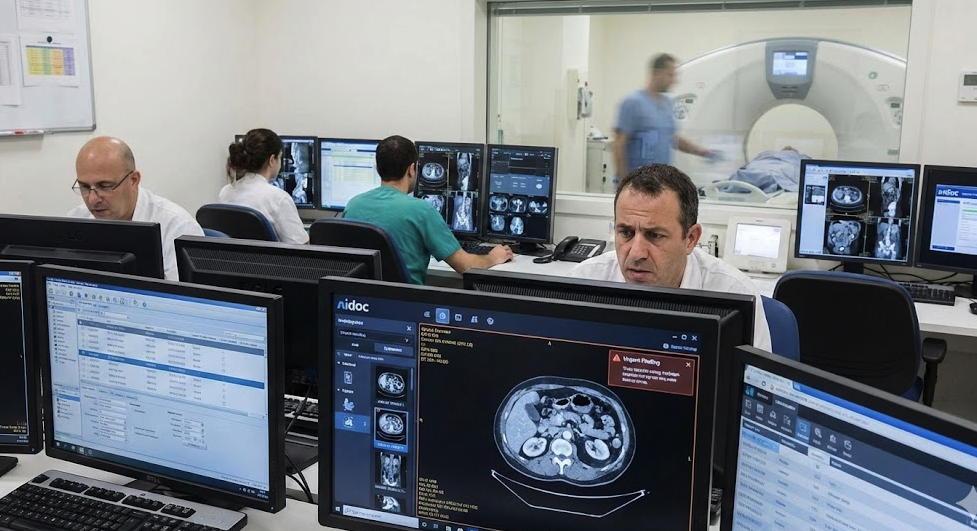
Hospitals are drowning in scans. Emergency departments keep filling, imaging queues keep growing, and radiologists are forced to read studies in strict order even when the next case in line may hide an urgent internal bleed or obstruction. Aidoc, an Israeli clinical AI company, says it now has FDA clearance for a single abdomen-CT triage workflow designed to surface suspected acute findings sooner—before they get buried in the backlog.
What’s new is the “bundling.” Instead of deploying a pile of separate, one-condition algorithms, Aidoc says its cleared system can triage 14 critical findings from one abdominal CT scan, consolidating 11 newly cleared indications with three previously cleared ones into one workflow.

That matters because the real-world bottleneck isn’t only detection—it’s deployment. Health systems have struggled to operationalize AI at scale when each tool is built for a single condition and needs its own integration, oversight, and change management. STAT notes this is why multi-condition clearance is a big moment in radiology AI: it shifts the fight from “can the model detect X?” to “can hospitals actually use this without breaking workflow?”
Aidoc’s pitch is that its foundation-model approach (CARE) can preserve accuracy while cutting the “alert fatigue” that kills adoption. The company points to FDA-reviewed pivotal-study results it says show mean sensitivity of 97% and mean specificity of 98% across the 11 newly cleared indications, plus a claimed order-of-magnitude reduction in false alerts versus leading single-condition solutions.
“The ability to bring key acute conditions together into a single workflow is a fundamental shift in how radiology departments operate,” said Dr. Heidi Beilis of WellSpan Health, which has deployed multiple AI tools and argues the consolidated approach can accelerate time-to-diagnosis for acute conditions.

Under the hood, Aidoc says the workflow runs through its aiOS platform—positioned as the “plumbing” for enterprise clinical AI, with data normalization, continuous performance monitoring, and governance built in. The company says its platform has analyzed more than 100 million patient cases, and it claims adoption across more than 1,600 medical centers worldwide—numbers meant to signal maturity, not hype, in a space where glossy demos often collapse at rollout.
This is also where Israel’s edge shows. Israel’s medtech ecosystem has learned to build products for high-pressure reality—tight staffing, high patient volume, and constant demand for faster decisions—then prove them under the world’s strictest regulators and busiest hospital networks. Aidoc says its roadmap aims to expand beyond abdomen CT to broader CT and X-ray workflows, and it’s working toward more end-to-end assistance, including automated draft report creation, as long as governance and clinical accountability stay intact.
Stay informed with the latest Jewish news, real-time Jewish breaking news, and in-depth Israel news coverage from our newsroom. For continuing updates, expert perspectives, and trusted reporting, visit our main news hub here.
Israel and the Middle East –
Jewish Politics –
Jewish Culture and Lifestyle –
Videos –
Jewish World
Source link