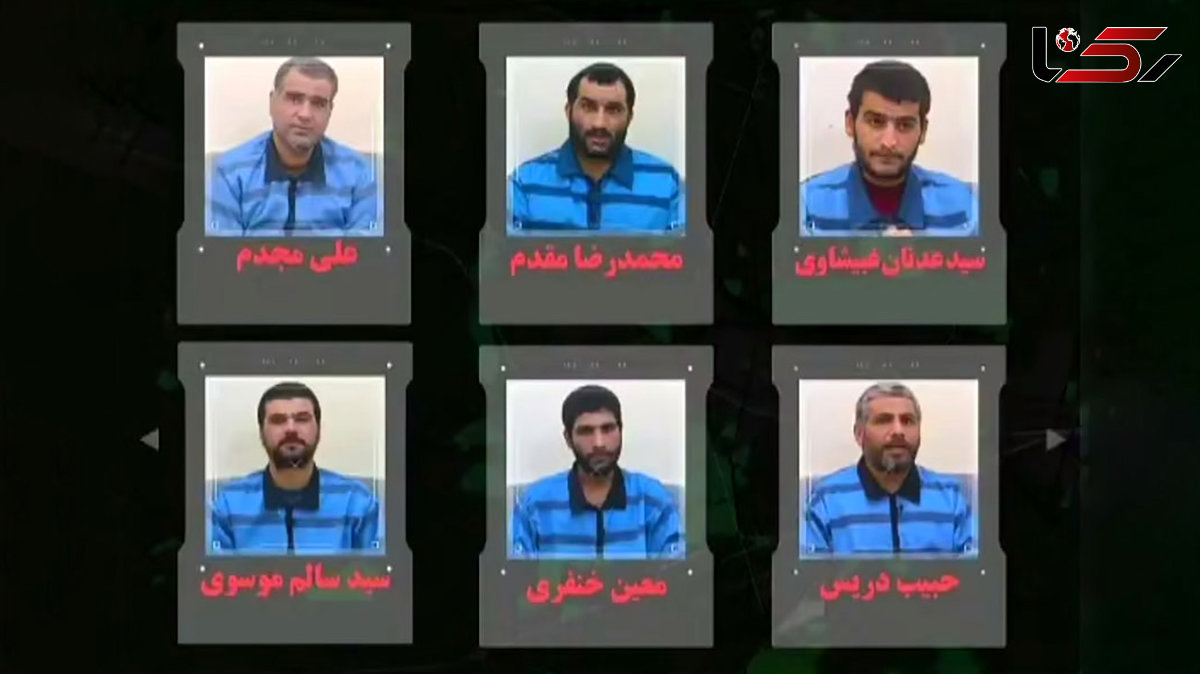
Iran executed six prisoners on Saturday accused of carrying out deadly attacks in the country’s oil-rich southwest on behalf of Israel.
Iranian authorities claim the six men killed police officers and security forces and orchestrated bombings targeting sites around Khorramshahr in the restive Khuzestan province. State television aired footage of one of the men “confessing” to the attacks, including throwing grenades at a Khorramshahr gas station and opening fire on security forces.
However, Hengaw for Human Rights challenges Iran’s narrative, noting that the six were Arab political prisoners arrested during November 2019 protests that began over a 50-200% fuel price increase and rapidly spread to hundreds of cities with calls for the overthrow of the government and Supreme Leader Ali Khamenei. All six were charged with membership in the Arab Struggle Movement for the Liberation of Ahvaz, a separatist group blamed for pipeline bombings and attacks throughout Khuzestan.
The Kurdish human rights organization insists the men were tortured and forced into giving televised confessions under duress.
A seventh prisoner identified as Saman Mohammadi Khiyareh was also hanged on Saturday over the 2009 assassination of Mamousta Sheikh al-Islam, a pro-government Sunni cleric in the Kurdish city of Sanandaj.
Activists have questioned Khiyareh’s case, noting he was only 15 or 16 at the time of the assassination, was arrested at 19 and held for more than a decade before his execution. His conviction relied on confessions extracted under torture, activists said, a practice Iranian courts use regularly to back up the trumped-up charges.
State executions have drastically escalated since President Massoud Pezeshkian took office in July 2024. At least 975 people were executed that year and more than 1,000 people so far in 2025, the highest annual figure recorded by Amnesty International in at least 15 years. Pezeshkian answers to Supreme Leader Ayatollah Ali Khamenei, who holds ultimate authority in the country.

Independent UN human rights experts have sounded the alarm about the sheer number of executions, calling it “a dramatic escalation that violates international human rights law,” according to a recent press release from the Office of the High Commissioner for Human Rights.
“With an average of more than nine hangings per day in recent weeks, Iran appears to be conducting executions at an industrial scale that defies all accepted standards of human rights protection,” the Office of the High Commissioner for Human Rights wrote in their September report.
Iran’s parliament passed a new espionage bill in late June, just after the 12-day war with Israel and the United States that left Iran’s main nuclear enrichment facilities severely damaged and more than 1,000 dead. The law drastically lowers the bar to make it easier for authorities to charge and execute dissidents by criminalizing routine activities like contact with diaspora media.
Source link