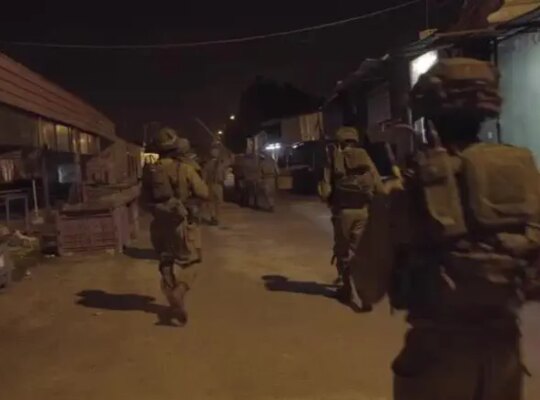
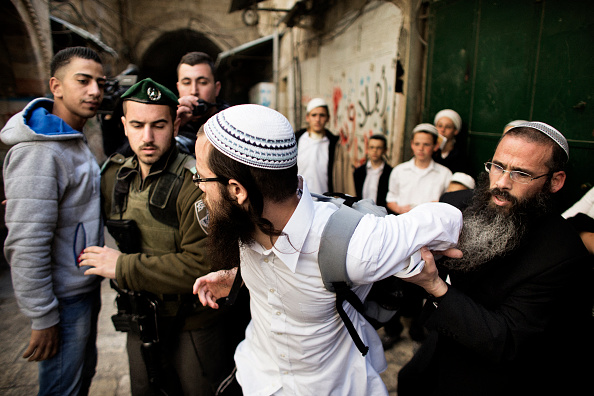
A group of Jewish worshippers, accompanied by police, ascended the Temple Mount to pray while Arab Muslims watched quietly Friday.
In 1967, to ease Arab-Israeli tensions, a policy was established allowing Jews to visit their holiest site but not to pray there, while Muslims could visit and pray at their third-holiest site. The Temple Mount was the site of Abraham’s near-sacrifice of Isaac according to Jewish tradition, as well as the site of the First and Second Temples. For Muslims, it’s the place where their prophet Mohammed is believed to have ascended to heaven.
The policy has created conflict over the decades, as some Jewish groups have insisted on praying there, at times escalating into riots that have included some stone-throwing toward Jewish worshippers at the Kotel below. Hamas named their Oct. 7 operation “Al-Aqsa Flood” in reference to this site, which is called “Al-Aqsa” in Arabic.

The international community accepted this status quo and even harshly criticized Ariel Sharon’s visit to the Temple Mount, which supposedly ignited the second intifada, without questioning the prohibition that prevents adherents of a particular religion to pray at their most religious site, which in any other context would constitute bigotry and discrimination, regardless of the fact that a majority of Orthodox Jews believe that stepping foot on this sacred ground is forbidden.
A reporter at the site spoke to some of the Muslims who were watching and received mixed reactions.
“It does disturb some people, but it doesn’t bother me,” said a man who gave his name as Ali. “If they do it quietly, it’s okay. People should worship God in the way they want to.”
But a small group of Muslim women reacted with visible disapproval.
“This place is for Islam, and Jews are supposed to pray at the Wall,” one of them said.
The number of Jews ascending the Temple Mount to pray has increased in recent years.

Rabbi Leo Dee, who lost his wife and two daughters in a terror attack several years ago, recently ascended the Temple Mount. On the day of his second wedding, he chose the Temple Mount as the spot to engage in the morning Shacharit service, explaining that for Jews, visiting the area on their wedding day is traditional. When a police officer told him his tefillin were not permitted, Rabbi Dee said, “I responded that the only place I thought it was forbidden was in concentration camps in Germany.”
The rabbi described the spiritual connection he feels while praying at Judaism’s holiest site.
“When you pray there, you pray as near as you can to where Jacob had his dream about the ladder, to where Abraham and his son Isaac were for the Akeida, to where our ancestors would sacrifice animals, and to the place where the Shechina dwells,” he said.
It remains unclear whether this represents a change in the status quo, with the Israeli authorities declaring no change, while proponents of change take it as a sign that the winds are shifting.
Stay informed with the latest Jewish news, real-time Jewish breaking news, and in-depth Israel news coverage from our newsroom. For continuing updates, expert perspectives, and trusted reporting, visit our main news hub here.
Israel and the Middle East –
Jewish Politics –
Jewish Culture and Lifestyle –
Videos –
Jewish World
Source link