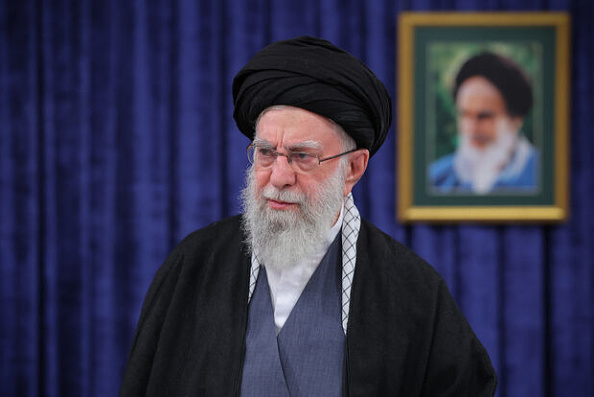
As Iran’s supreme leader, Ali Khamenei, and his son and potential successor are increasingly spending their time in hiding, Khamenei has been making contingency plans to keep the authoritarian regime intact and protect it from collapse by appointing layers of successors, beginning with his most trusted adviser, Ali Larijani.
After the June war in which both Israel and the United States attacked Iran, much of Iran’s leadership was decimated. In order to centralize power and restore security, Khamenei appointed Larijani to head the Supreme National Security Council.
Larijani comes to the job with an impressive resume. A member of a powerful political family, Larijani served as a commander of the Islamic Revolutionary Guard Corps (IRGC) and as Speaker of Parliament. He negotiated a deal with China worth billions, and amid the current regional crises and conflict with the U.S., he has been liaising with powerful allies such as Russia and China on behalf of Iran, as well as regional players such as Qatar and Oman. He has also taken a leadership role in the current nuclear negotiations, overseeing the talks between Iranian Foreign Minister Abbas Araghchi and his U.S. counterparts, Steve Witkoff and Jared Kushner.
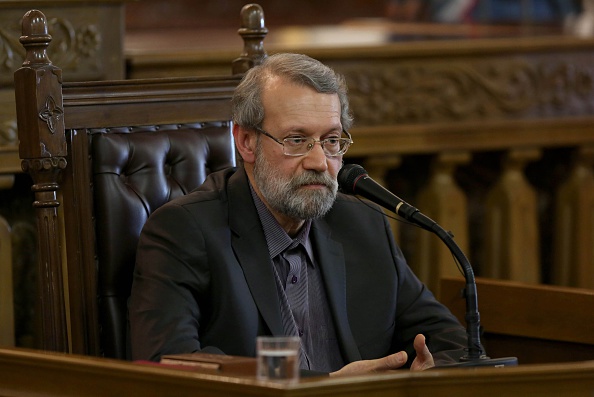
Khamenei has appointed four layers of successors for each leader and has instructed them to each appoint several successors of their own to ensure the government continues to run efficiently if he is killed, as well as a number of his successors. By appointing Larijani to the key role — he is popularly seen as the one who will take complete control even if he can’t be the supreme leader, a role that can only be filled by a Shiite — Khamenei has effectively sidelined Iranian President Masoud Pezeshkian, whose role has been shrinking as Larijani’s stature grows.
According to a report from Iran International, Larijani and other senior Iranian officials carried suitcases of cash with them on a trip to Lebanon, whereupon they delivered the cash to Hezbollah.
Larijani oversaw the brutal crackdown of protesters in January that saw thousands — and perhaps tens of thousands — killed, with some reports putting the death toll at upwards of 36,000. As a result, the de facto leader of Iran and his many layers of successors, i.e., anyone in his inner circle, are hated by the Iranian people. The outcome of a strike that takes out some of these layers is therefore anything but certain.
Stay informed with the latest Jewish news, real-time Jewish breaking news, and in-depth Israel news coverage from our newsroom. For continuing updates, expert perspectives, and trusted reporting, visit our main news hub here.
Israel and the Middle East –
Jewish Politics –
Jewish Culture and Lifestyle –
Videos –
Jewish World
Source link