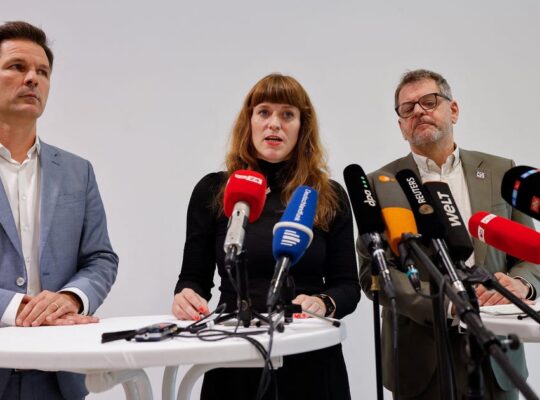

A clip has surfaced of Democratic Senate candidate Abdul El-Sayed’s sister, Eman Abdelhadi, reading a passage from a book she co-authored with M.E. O’Brien in which she imagines the “final intifada,” when Israel falls in an Oct. 7-like assault. The book was published in January 2024, a few months after the worst tragedy to befall the Jewish people since the Holocaust.
In a fictional interview set in 2067, Abdelhadi imagined herself speaking with a man who had participated in the attack as a young man about 30 years before.
Speaking about the book, the Michigan candidate’s sister explained that each chapter is an interview presenting an oral history from a fictional character. In the chapter under discussion, she imagined herself interviewing a man named Hassan “about their participation in the final intifada and the liberation of Palestine, and they say it was a mass insurrection that started in the early 30s and ended with the liberation of Palestine in 38.”
“In the 20s, you had massive boycotts of Israel by individuals, companies, universities, and industries all over the world,” her character said. “The state couldn’t afford to keep up the luxuries they gave to working-class and middle-class Jews because the global economy was faltering.”
“They say, ‘What were you plotting?’ They say, ‘Resistance, like you know, guerrilla ops, mostly targeting the border to Gaza,’” the character Hassan said.
“It took a year of intense planning and coordinating with resistance fighters across Palestine,” the character Hassan said. “But eventually, the border between Gaza and the rest of Palestine fell. The IDF couldn’t hold out between the mass defections, the international condemnations, the weapons and supplies drying up.”
Critics are focusing on what appears next to be a reference to a future Oct. 7.
“I say, tell me about the day the border fell, and Hassan pauses for a long time,” Abdelhadi said.
“It was the most beautiful day of my life, bombing the borders, blowing up military outposts, and all that,” she had him respond. “But most people were just organizers. Those of us that were armed started shooting at them. Some people made Molotov cocktails.”
Left out of the clip is how Abdelhadi projects intifada-like behavior onto the Israelis. Her character describes an incident in which Israelis shoot up a school bus full of children, an echo of Palestinian suicide bombings that blew up buses during the Second Intifada. The character adds that this sparked a million-person march over the border that eventually overwhelmed the Israelis, leading to the success of the “final intifada.”
For a course at Temple University in Philadelphia, Pa., called Intellectual History, a professor assigned several passages from Abdelhadi’s book, including this one, for her students to choose from for a writing assignment.
Writing instructions included such directions as the following:
“Find a passage that illustrates a way that the person whose story is being recorded challenges dominant expectations of whose view of history we should listen to, and talk about how they challenge these expectations.”
Stay informed with the latest Jewish news, real-time Jewish breaking news, and in-depth Israel news coverage from our newsroom. For continuing updates, expert perspectives, and trusted reporting, visit our main news hub here.
Israel and the Middle East –
Jewish Politics –
Jewish Culture and Lifestyle –
Videos –
Jewish World
Source link