
A month after Israel’s last general election in November 2022, ChatGPT was launched. In the four years since, though Benjamin Netanyahu’s government has remained in power, political campaigns and the available technology have changed dramatically.
A Haaretz investigation has found a slew of new campaign and influence tools, among them bots that try to rig online polls in favor of a party’s candidates. The new tools, experts say, show how the laws designed to safeguard election integrity are woefully obsolete.
Drawn up in the 1950s, these laws were updated recently to address new threats including deepfakes and other AI-generated campaigning ploys. But sources across the parties’ campaigns and senior figures at the tech companies serving them have exposed the new toolbox of Israel’s election industry, a full range of unregulated technologies.
These are the parties’ instruments for identifying and persuading voters, including bots and avatars, advanced intelligence tools and efforts to engineer public opinion through AI chatbots like Claude and ChatGPT. Some of these tools are illegal, and none are subject to any election oversight.


Polling bots
Bots is a much overused term that just means software performing actions usually done by humans; it does this automatically and at scale. Bots have long been used in digital marketing to inflate view counts and boost content’s standing on sites like Google. Campaign managers say bots are also widespread in politics. Parties buy them to inflate view counts across social media, or to comment on and share content to boost the party’s apparent “organic” reach.
But ahead of the October 27 election, a new service is being offered: a fleet of bots that vote in online polls and skew the results of unregulated surveys. Alongside polls by respected institutes for media outlets, social media platforms and the wider web are flooded with open polls that let any user vote.

One right-leaning popular Instagram news account recently published a poll asking who is more suited to be prime minister, Naftali Bennett or Gadi Eisenkot. It drew 312,000 views and over 140,000 votes. An unregulated poll like this is relatively easy to manipulate – and that’s exactly the service now being offered.
The bots that are sold to campaigns scan social media and the wider internet, identify open polls and systematically vote for their candidate. Also, some of the more advanced avatars – digital personas that seem to be real people – have real phone numbers and can vote in polls distributed via text messaging or in large WhatsApp and Telegram groups. Industry sources say the use of such bots in the current election cycle is massive.
Although such polls have no statistical credibility, they matter. They can be amplified online, generate momentum for a party or damage a rival’s image. A party near Israel’s 3.25 percent electoral threshold might use them to falsely reassure hesitant voters that the party faces no danger in qualifying for the Knesset.
The Israeli authorities have long been concerned by the impact on voters of polls, which are forbidden in the last few days before an election. This month, the Central Elections Committee took this caution much further: It told media outlets to submit data on every published poll within 24 hours.
But the directive applies only to polls using recognized statistical methods, not to open internet polls. The law requires anyone publishing a nonstatistically significant poll to state clearly that its results do not reflect public opinion. But a Haaretz review found that this is not yet being done.


Agents for hire
Bad actors in the current election campaign are also using fake accounts more sophisticated than bots – avatars that pose as real users and function as influence agents. Haaretz has found that at least two avatar networks have been set up ahead of the vote, serving the campaigns of candidates across the political spectrum.
Avatars post and share content, comment on articles and other posts, and amplify campaign messages. Unlike a bot, which is fully automated, an avatar is usually partially maintained by a human and is designed to look indistinguishable from a real person. Some of these services also offer avatars for identifying closed groups of potential voters, infiltrating them and only then plying targeted influence.
“This isn’t something you can build overnight – there’s a process. Building a network like this requires real infrastructure,” says a senior figure at a company working with one of the campaigns.
A 2023 Haaretz-TheMarker investigation revealed that an Israeli firm sold software for creating such accounts at scale and also maintained a roster of tens of thousands of fake identities as part of election interference and a disinformation service it offered. This was the first time such disinformation software was exposed, but it’s far from the only one out there.
In 2024, Haaretz revealed that in the wake of the digital backlash that followed October 7, Israel bought a mass-avatar influence system developed by another contractor and deployed by it, which was used to troll the pages of U.S. lawmakers. But it was caught by Meta, which took the campaign down, causing embarrassment in Israel.
Since then, more Israeli companies offering similar technologies have emerged, and though these products are usually exported as part of campaigns run in other countries, many times by Israeli contractors, they are now targeting Israelis.
Volunteer armies
Alongside the fictitious digital activity, campaigns recruit real users for organized online influence. “Imagine a setup where about 6,000 supporters receive a daily briefing with messages, images and videos they’re expected to amplify, and links they’re asked to comment on,” says a political consultant for one of the campaigns.
Parties build up volunteer armies through mass text messaging and promotion campaigns. They deploy these digital conscripts to shape a discourse that seems organic but is dictated from above.
Here, too, artificial intelligence plays a role. AI agents scan the internet for discussion hubs that volunteers are directed to engage with, and AI tools draft the messages and comments that these innocent users post. Such technologies were launched after October 7, initially developed as part of ad hoc Israel PR initiatives by volunteers. These apps and capabilities are now being turned inward toward Israeli hearts and minds.
ADINT
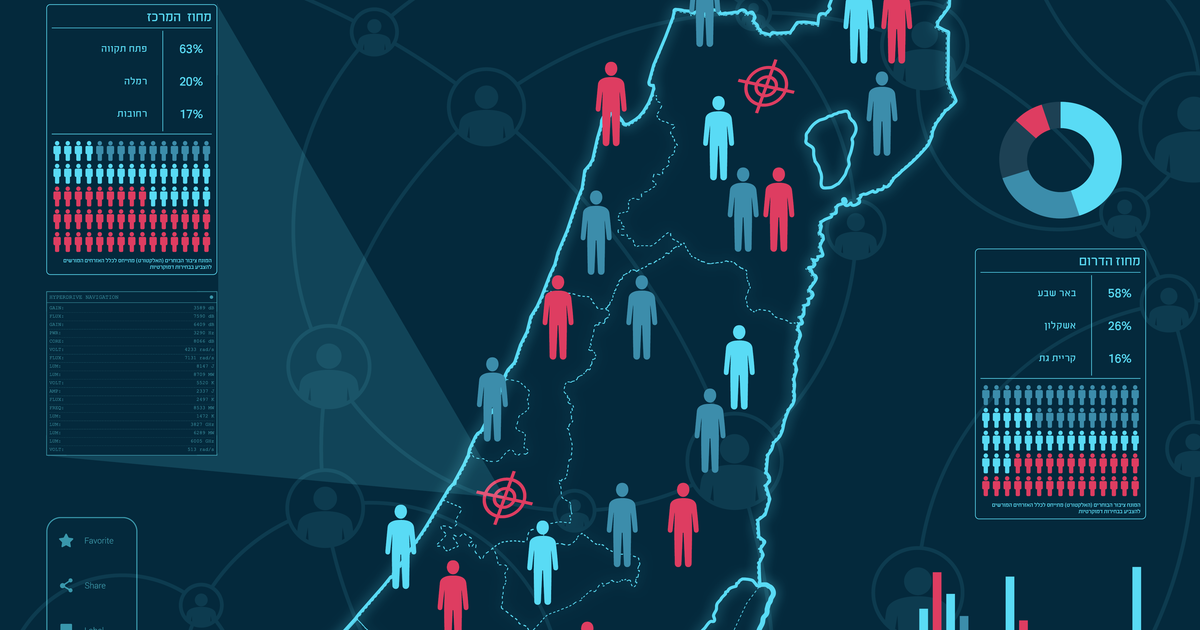
At the heart of the election operation are basic software systems that allow parties to collect and manage vast databases of voter information – to locate committed supporters and wavering former voters, and even identify a rival’s base to suppress its turnout.
These are benign programs – or at least they began that way. The foundation is the voter registry, provided by the Interior Ministry ahead of every election. Using AI, parties enrich each person’s record with contact details and political indicators, cross-referencing massive commercial databases to match voter names with phone numbers or email addresses. Though campaigns have always worked this way, with the help of AI, bigger and more diverse datasets can be integrated, including new types of data that have emerged in recent years to serve the mobile advertising market.
To profile voters, some parties use campaign apps like Elector, where supporters tag each of their contacts’ political leanings.
Parties also use advertising intelligence, ADINT, a technology used by intelligence agencies and exposed in a number of Haaretz investigations as leaking to the private market. With ADINT, data collected from apps and smartphones and sold to advertisers for marketing purposes is turned into geolocation data that allows tracking and targeting.
We may not realize it, but each of us has a unique digital ad identifier, which supposedly is anonymous. But as Haaretz has revealed, companies have developed de-anonymization capabilities linking these identifiers to phone numbers – capabilities once reserved for espionage such as tracking nuclear scientists in Iran. Now such capabilities and the data behind them are sold to commercial clients that, thanks to AI, can process data at a scale once considered too big for marketers or campaigns.

However, according to the sources in Israeli campaigns and at tech companies, political campaigns are deploying this know-how alongside their VRM (Voter Relations Management) systems and get-out-the-vote apps like Elector.
ADINT can identify anyone who follows a party on Facebook or joins a group related to a party; some companies even conduct polls whose real purpose is to collect data on the respondents. To obtain this intelligence, parties buy databases; some of the means for this are more legal than others. “There’s a lot less than three months left, and the race to obtain voter data is at its peak,” a campaign operative says.
At the center of the data effort are VRM systems. Two companies dominate the market, but during this election cycle, parties have also decided to build their own systems using Anthropic’s Claude and other AI models that can code and build software.
These systems are also used on Election Day. Observers report which targeted voters have voted, and headquarters sends operatives to those who have not.
But this week, the head of the Central Elections Committee, Justice Noam Sohlberg, barred observers from reporting to their parties in real time on who has voted, which he said “constitutes a violation of privacy.” The ruling riled the ultra-Orthodox parties and Likud, the main users of these systems.

Ramped-up robocalls
Once the relevant voters have been identified, parties target them through paid ads, social media and phone calls, as well as SMS and WhatsApp messages. Companies specializing in mass WhatsApp campaigns have emerged despite Meta’s policy of blocking such efforts.
The biggest technological change involves the oldest tool – phone calls. Robocalls have existed since the ’90s but have evolved beyond recognition. Industry sources describe AI systems that tailor each call to its recipient, like “Hello Omer, this is Benjamin Netanyahu,” and respond to questions and responses using answers drawn from a preprepared set. It all sounds real, an example of how AI is upgrading old election technologies.
Parties are also investing in AI as actual influence channels. In the past, the focus was billboards and posters, then search engine optimization, SEO; for example, getting a party’s message high on a Google search. Now anyone looking to reach a wide audience concentrates on penetrating AI-based chatbots – also called GEO, with the “G” standing for GPT.
Campaigns build online content so that AI engines reflect it in their answers, absorbing positive information about a candidate and negative information about rivals.
A Haaretz test found that chatbots avoid direct answers to questions like “Who is the most suitable candidate for prime minister?” But the more specific the question, the less cautious they become.
When we asked which candidate is most likely to rehabilitate Israel’s standing around the world, ChatGPT omitted one prominent candidate, Avigdor Lieberman, citing “[Yair] Lapid, Bennett or Eisenkot as having potential for this.” But it qualified: “There is no professional or public consensus that any one candidate is clearly the most suitable.”
Is any of this legal?
The gap between privacy laws and election laws leaves campaign managers significant room to maneuver, especially given that no government body is responsible for regulating the election tech and capabilities described in this article.
“Elections are a mass casualty event for privacy,” said attorney and activist Shahar Ben Meir, who petitioned the Central Elections Committee to ban parties from using dedicated campaign apps. Political campaigns, he said, “engage in a range of actions that significantly violate privacy, and there is considerable doubt regarding their legality.”
According to Ben Meir, “In any normal country, an expert committee is appointed to set guidelines for protecting voter privacy in the age of Big Data, and these are implemented through legislation and regulation.”

Ben Meir believes that Israel’s shortfall is no accident. “This failure has direct culprits – Prime Minister Netanyahu and the party he leads, who prefer to operate in an environment of outdated laws,” Ben Meir says. “Ofer Golan, the former head of Likud’s campaign headquarters, made this clear when he said in an interview in 2019: ‘We have no red lines. The goal is to win – we’ll do damage control later.'”
The hardest test may come after the polls close, warns Tehilla Shwartz Altshuler, head of the Democracy in the Information Age program at the Israel Democracy Institute. “These tools can be used not only to promote a candidate, harm a rival or influence turnout, but to generate a real-time stolen-election narrative and undermine public trust in the elections committee and the results,” she says.
“In such a scenario, all existing tools would need to be deployed swiftly, decisively and with a deliberate interpretation of the law, because public trust lost in the hours after the polls close will be very hard to restore by a legal ruling issued days later.”