
Congratulations to Pluto, Ceres, Eris, Haumea and Makemake—there may be a new sibling to welcome into the dwarf planet family.
On Tuesday astronomers at the Vera C. Rubin Observatory announced the discovery of a new dwarf planet candidate in a distant part of the solar system beyond Neptune’s orbit. The new object doesn’t have an official name yet and is instead going by its provisional designation—2026 ED138.
The discovery was made by running billions of pieces of data collected by the Rubin Observatory through a search code developed by Center for Astrophysics | Harvard & Smithsonian astronomers Matthew Holman and Kevin Napier.
On supporting science journalism
If you’re enjoying this article, consider supporting our award-winning journalism by subscribing. By purchasing a subscription you are helping to ensure the future of impactful stories about the discoveries and ideas shaping our world today.
“My first reaction was one of excited disbelief,” Holman said in a statement. “Objects like this are very rare, so I immediately started checking whether I or the code had done something wrong.”
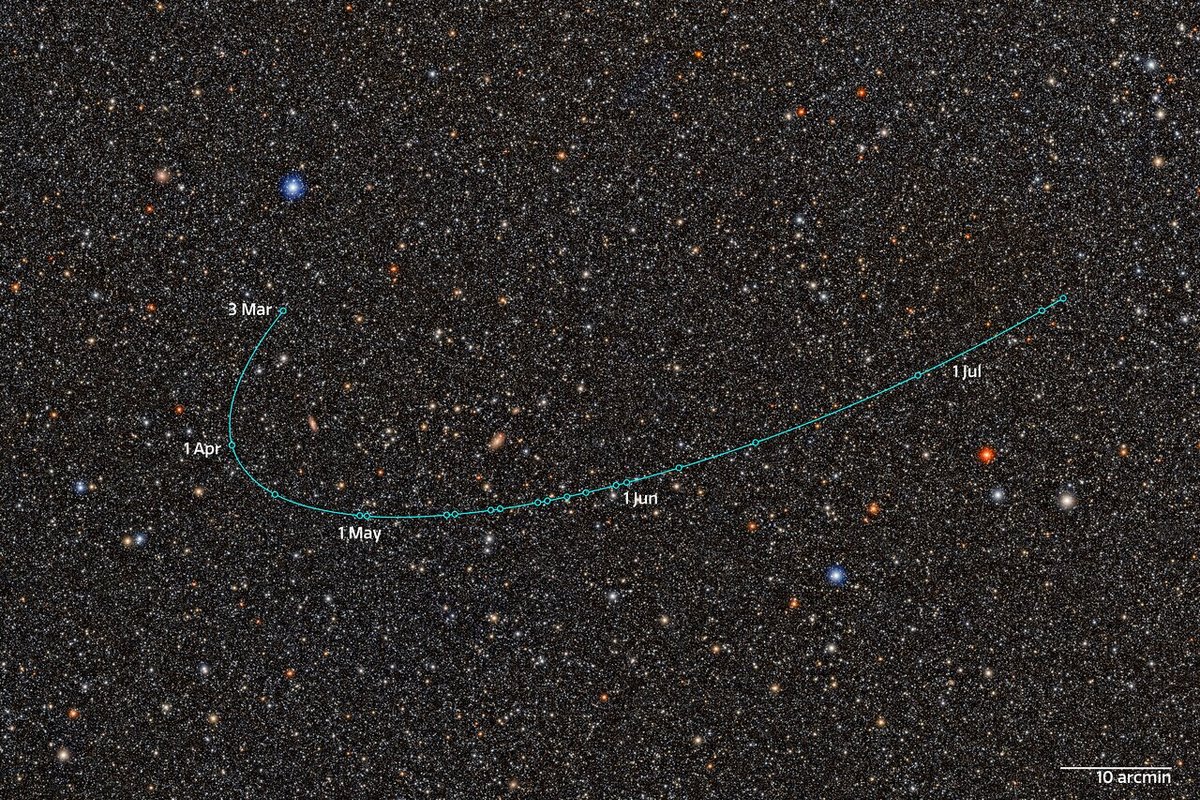
When Holman and his colleague Mario Jurić of the University of Washington went to double-check, they found 30 more observations of the object by Rubin that dated to between March and July 2026. Looking at other observation tools, the pair found even more sightings going back to 2016. Together, these data allowed the astronomers to begin mapping out 2026 ED138’s orbit.
The suspected dwarf planet is about 46 times as far from the sun as Earth, making it even more remote than Pluto, which is just 40 times as far. The object is also tilted off the solar system’s plane by around 25 degrees, an arrangement that could be linked to disruptions caused by Neptune’s gravitational pull.
Initial measurements indicate that 2026 ED138 has a diameter between 600 and 1,500 kilometers (373 and 932 miles), which makes it one of the largest dwarf planet candidates yet detected. But size isn’t all that matters: further observations are required to determine if the object has enough mass to be pulled into a round shape, which is a key requirement for a dwarf planet.
Despite its size, 2026 ED138 was able to avoid detection for all these years because it’s located in a part of the night sky that’s crowded with stars whose light drowned it out. The Vera C. Rubin observatory, which is loaded with state-of-the-art, powerful instruments and only recently came online, made the discovery possible. Now that the object has been identified, astronomers can get to work on learning more about it to see if it can join Pluto and the others in the dwarf planet family.
“If confirmed as a dwarf planet, ED138 would join a very small family of worlds,” Holman said. “Rubin will image the whole southern sky again and again for ten years, so any others hiding in the places earlier surveys skipped are now within reach.”
Subscribe to Support Independent Journalism
Great science journalism requires human expertise, time, effort and creativity. And it costs money. That’s why I and the journalists here at Scientific American hope you’ll join our community.
When you subscribe, you are supporting staff and freelance journalists who are passionate about telling science stories that are true, important and compelling. Our editors and reporters are often experts in their fields, which means they understand the nuances of big discoveries and can untangle the breakthroughs from the hype. With a subscription, you are also supporting rigorous fact-checking to ensure the words we publish are precise and accurate. And you’re supporting original illustrations, graphics and photos that bring you closer to an advanced laboratory, an ice sheet in Antarctica or a space mission in orbit. You’re helping us craft other types of high-quality journalism as well: Our newsletters are carefully written, edited and curated by staffers you have or will come to know and love. Our Science Quickly podcast is based on original reporting, collaboration with editors and scientists and exacting production.
Subscriptions keep this engine running so we can continue to deliver thoughtful, rigorous and independent science journalism to you. In an era of viral misinformation, this work is crucial. If you value what we do, I hope you’ll consider joining us as a subscriber
Source link