
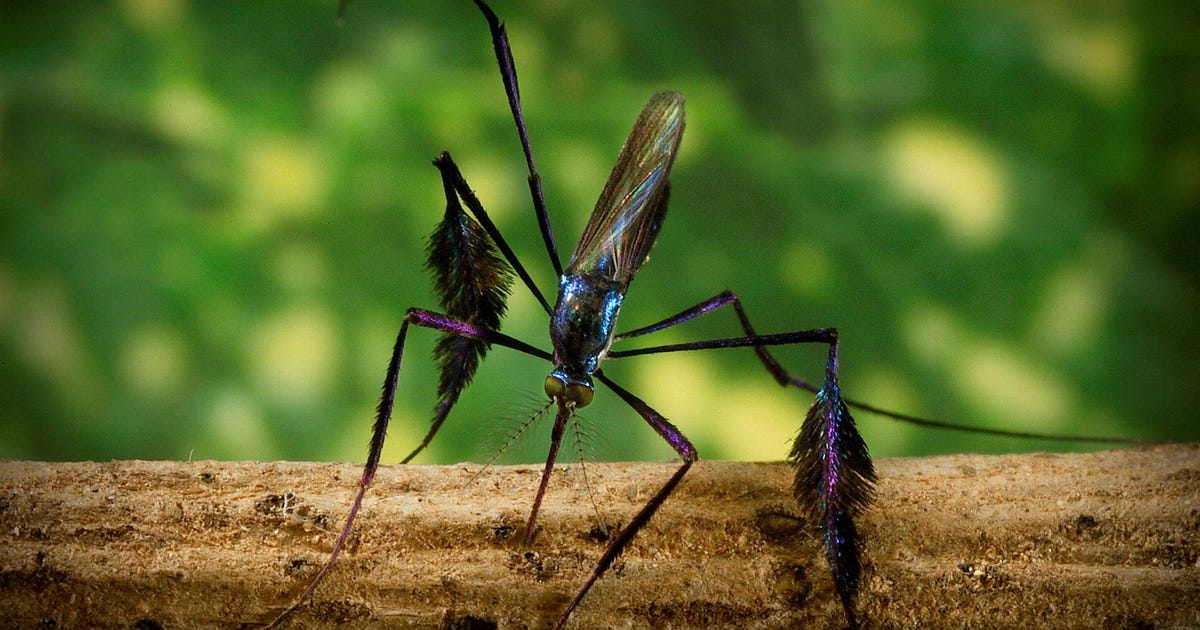
There are more than 3,500 species of mosquito. Aren’t you happy to know that? Moreover, new ones are getting discovered, including through the revelation that some species we know and don’t love, like Anopheles culex, are more than one species. But hey, biodiversity is good.
Even better is the knowledge that mosquitoes thrive on all the continents except Antarctica and are very diverse, including in their diet. Most mosquitoes consume fruit and nectar. Among the hematophagous ones, meaning the ones that suck blood, all the ones doing so are females.
Mosquitoes that do eat blood can be generalist: If it moves, they’ll bite it – reptiles, amphibians, birds, mammals, and even some other insects like pre-metamorphosed caterpillars. And us of course. Others are highly specific in their dietary targets. The finicky Culiseta melanura only feeds on passerine (perching) birds.
But there are mosquitoes that only feed on humans, such as Aedes aegypti which despite its name and African origin, has gone global.
The burning question is this. At what point did mosquitoes notice humanity out of the hordes of hairy Animalia thronging the planet, and start to specialize in our bareskin niche?
In Southeast Asia, it didn’t emerge only with the arrival of modern humans about 70,000 years ago (say for the sake of argument). It happened about 1.8 million years ago when hominins arrived in the Sundaland in Southeast Asia and became established, according to a new paper published Thursday in the Nature journal Scientific Reports.

A single species within the group Anopheles leucosphyrus that had fed on monkeys beforehand developed a taste for these early hominins, Upasana Shyamsunder Singh of the University of Manchester and colleagues posit. From it, all blood-sucking mosquitoes that prefer humans would descend, they suggest.
In fact, their genetic analysis of 40 mosquitoes of 11 species belonging to the Anopheles leucosphyrus group (some preferring humans, some non-human primates) supports an emerging thesis, that hominins spread to Asia at least 1.8 million years ago, the team stresses.
We are not suggesting that hominin blood tasted better or were more nutritious than that of lizards or monkeys. We are suggesting that once they arrived, hominins were just another target for the mosquitoes, and got targeted. Over time, the outcome would be niche specialization.
We can also speculate that African mosquitoes were perfectly happy to dine on the many and myriad hominins thronging the continent from perhaps 7 million years ago, but the new paper focuses on Southeast Asia, where it is now believed that hominins, possibly the great and doughty Homo erectus himself, had arrived about 1.8 million years ago. And lo, they were noticed.

Eat the arrivistes
Mosquitoes originated in the Jurassic, which is defined as 201 to 143 million years ago, it is thought. When the Jurassic began, Earth consisted mainly of ocean and the supercontinent Pangaea, which would break up into Laurasia in the north and Gondwana in the south.
Hematophagous (blood-eating) mosquitoes emerging at any point in the Jurassic, if they did, would have supped on the same animals they do today – earlier versions of reptiles, birds, mammals and the rest.
The earliest actual fossil we have of these insects are two specimens in Lebanese amber from about 130 million years ago and they were a shocker, because they were hematophagous males: they had, both the mascule accoutrements and beautifully preserved proboscises to suck blood.
Today the only mosquitoes who drink blood are fertilized females. They need it to obtain iron and protein to make their babies. Generally it is suspected in paleoentomological circles that hematophagy evolved as a transition from sucking nectar but in Lebanon there they were: male mosquitoes drinking blood 130 million years ago (reported in 2023), which the paleontologist Dany Azar of the Chinese Academy of Sciences told Reuters, suggested that all mosquitoes were originally hematophagous.

Maybe they were, maybe not. By the time hominins evolved, mosquitoes were old hat and had diverged to the point that most were fruit eaters, and some were hematophagous. A niche emerged in which some developed a penchant for Homo blood specifically, which the team suggests happened 1.8 million years ago in the Sundaland.
This discovert also, while about it, supports the scenario of early hominin arrival in Asia.
The spread of humanity before our species even emerged is a red-hot topic these days. Homo erectus skulls in China thought to be a million years old were recently redated to 1.8 million years ago. Ergo hominins had reached Eurasia from Africa probably about 2 million years ago and had spread much farther east than had been realized. Based on the skulls in central China, arrival in Southeast Asia by 1.8 million years ago is plausible.
How did Singh, Catherine Walton and the team deduce that the peripatetic hominins came under entomological assault? They sequenced the DNA of 38 mosquitoes from 11 species in the Leucosphyrus group, which were caught between 1992 and 2020 in Southeast Asia. They then used accepted techniques, including estimates of DNA mutation rates, to reconstruct the evolutionary history of these mosquitoes.
In the specific group of Leucosphyrus, the authors estimate that the mutation conferring attraction to the Homo group evolved once, between 2.9 and 1.6 million years ago in the Sundaland. Before that, their ancestors fed on monkeys.
So what have we? Anthropophilic mosquito diets didn’t start with modern humans. An overlap between research showing Homo erectus in eastern Asia 1.8 million years ago and the emergence of a taste for hominin in Leucosphyrus mosquitoes, the team claims. After all, modern humans wouldn’t reach Southeast Asia until about 70,000 years ago, give or take so they could not possibly have been the insects’ first human feast.
So, possibly, was this species of Leucosphyrus the plague of early humans in Asia, the first man-eater or at least hominin-eater?
Although there were mosquitoes and hominins in Africa far earlier, the team points out that previously published estimates place the evolution of preference for humans in African malaria carriers Anopheles gambiae and Anopheles coluzzii only around 60,000 years ago.
Why would the mosquitoes switch from monkeys to erectus, and later to us, if they did?
Niche emergence is a thing and the authors propose that the evolution of a hankering for the human smell in Leucosphyrus may have required H. erectus to be present in substantial numbers in Sundaland around 1.8 million years ago. Then, once an anthrophilic species of mosquito began to latch onto the veins of erectus, it gave rise to many more such species that would prefer us, including ones that transmit terrible diseases like malaria and Zika. To monkeys too.