
Playing Mozart to your belly may cure what ails you, but not your future child. There is no evidence that exposure to classical music boosts intelligence in infants let alone the unborn, despite a 1993 finding that college students did (slightly) better on spatial reasoning tasks after hearing a sonata, which led to all sorts of business ventures. Conversely, there are reams of evidence that what you eat, drink, inhale and feel can impact Baby.
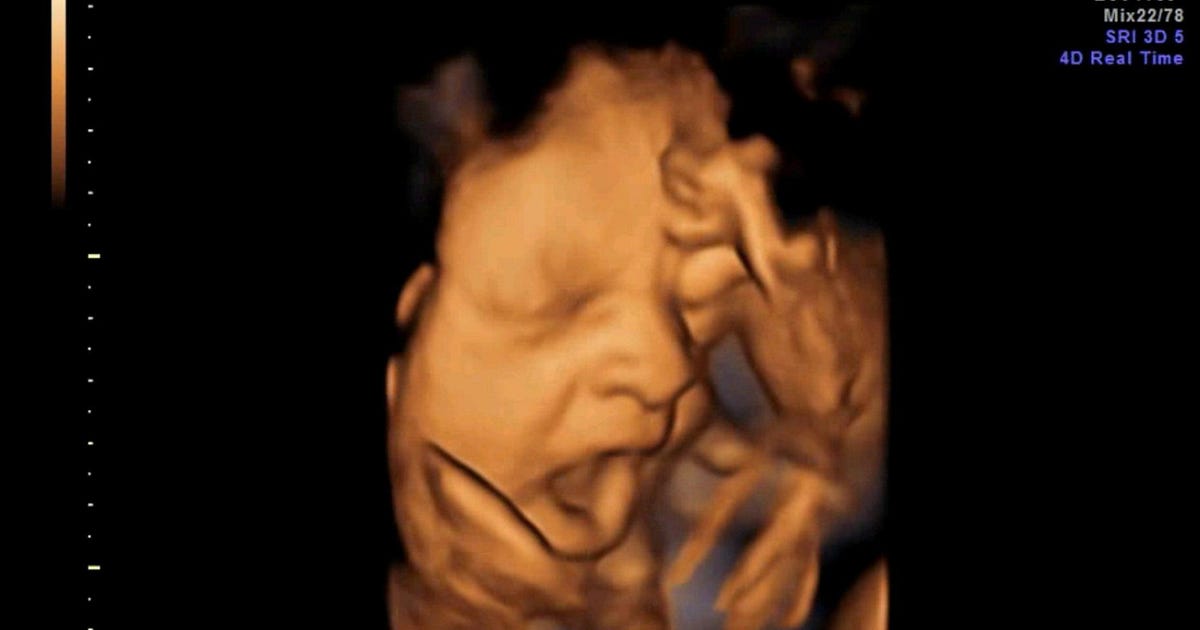
How about feeling bored? What interests the preborn set is an imponderable but now a new study demonstrates that yawning can be contagious even in utero. How was that achieved? Eliciting yawning behavior in the mother increases yawning in the fetus, Giulia d’Adamo of the University of Parma and colleagues reported Tuesday in the Cell journal Current Biology.
How strange is this? Well, we already knew that babies yawn in the womb as early as the 11th week. It had been assumed that prenatal yawning was entirely physiologically driven, and that post-birth yawning can be either physiological or “shaped by the social context,” which means, yawnies are caught from the people around us.
Therefore, fetuses in the womb catching yawning from Mama was unexpected.

The primordial gap
Yawning sounds like a physical triviality but it is a primordial behavior that goes back to the dawn of vertebrate evolution, at least on land, as is implied by the observation that all terrestrial vertebrates yawn.
The fact that all animals yawn – that this is a behavior conserved throughout evolution – also implies that the behavior has underappreciated importance.
Crocodiles, snakes and frogs yawn, though in their case we call it mouth-gaping, and we associate it with an attempt to cool off, chemically analyze the environment or prepare to swallow a meal.
Birds yawn and again, we assume they’re not unlocking their beaks because they’re finding existence tedious, but have a physiological itch to scratch.

Could the evolution of yawning go back even further, to the first vertebrates in the primordial seas? Do fish yawn? Ask them. Some fish do exhibit mouth-gaping, lending to speculation that yawning emerged in the early jawed fishes.
So, having glanced at gap-mouthed Animalia, why do humans yawn? Since we can ask and we can strap ourselves to lab equipment without provoking PETA, some deductions have been made – there can be more than one reason, by the way.
Some think a key impetus is the same as in birds and crocodiles: to cool the brain. This hypothesis was supported by a 2014 study that found human pedestrians yawn more often in summer than in winter.
We do? How exactly does yawning cool the brain? Breathing in cools the blood vessels in the mouth and nose, and the muscular movements involved in opening the jaws increases the flow of cooled blood to the brain. It’s even postulated that when we get bored or sleepy, our brain heats up, so we yawn to cool it.
Really? Being bored makes our brain hot? Well, it’s been proven that brain temperature affects brain activity. Warm neurons are sluggish, but when cooled, they regain excitability.
The implication in any case is that in the adult animal, yawning is important; in higher vertebrates such as cats, dogs and we monkeys, it can be an involuntary reflex or it can be a social behavior – somebody by us yawns and then we do too. It begins with opening the mouth, taking a deep breath and exhaling slowly. That is contagious yawning, which has been postulated to aid in group cohesion (though failure to yawn in a group situation doesn’t necessarily attest to sociopathy), and one wouldn’t expect to find it in Fetus.

Is baby bored?
Back in the womb, fetal yawns display a motor pattern similar to adult yawns, and it has been suggested that their yawning somehow supports nervous system development. Okay, but then why would they increase yawning when mother does?
Note that the test sample was 28 pregnant women in the 32nd week. Facial movements of the women and fetuses were captured by video and ultrasound, respectively, and the images were subjected to “frame-by-frame lip aperture tracking” – mouth open or closed. The aim was to see if maternal yawns modulated yawning in utero.
We will skip beyond the statistical defense of their interpretation of mouth movements in parent and fetus. Their findings include that the delay of baby yawning after the mother, was similar to the maternal response to contagious video stimulation; they also demonstrated that maternal and fetal yawns are coupled in time.
So what have we? Indication that an ancient behavior in the fetus that had been assumed to have a purely physical basis can also triggered by the mother. We think of the time in the womb as solely a stage of internally programmed maturation, but this shows more.
Fetuses yawn a lot, by the way. Separate work noted high variability but estimates the median frequency at two yawns an hour in the second and third trimesters – similar to the rate observed in premature neonates.
Maybe baby isn’t bored, it’s stressing. Separate work in 2021 reported a negative relationship between yawning frequencies and birth weight (in healthy fetuses), which could indicate that yawning in the womb signals some sort of mild stress. Ergo high yawning frequencies can be a predictor of low birth weight which could, that paper suggested, help doctors anticipate slightly problematic outcomes even for full-term pregnancies, though how pragmatic that finding is remains to be seen.