
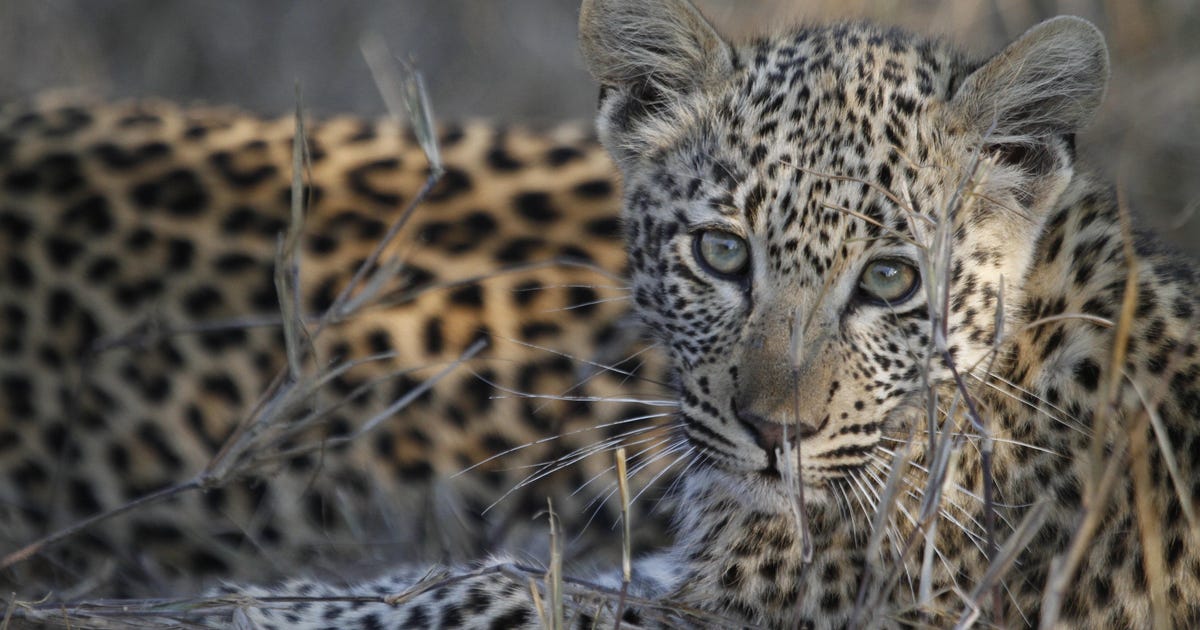
Leopards are the most iconic of cats, in the fashion world. Ancient demonstrations of manliness awarded more points for killing lions mano-a-gatto but for coats, the rosettes win hands down. Hence the leopard has become critically endangered everywhere.
In Africa, hunting leopards is widely outlawed but there are yawning loopholes and poaching is by definition under-reported. Many nations still allow leopards to be hunted whether for “fun” with a costly permit, or to obtain their pelt for traditional rites. Zambia is one such nation.
But the cats’ decline could be moderated, and their final extirpation postponed, by the radical idea of replacing real fur in ceremonies with fake fur. It may sound crazy but in Zambia, it’s working, according to an academic report based on a project by the Panthera conservation organization.
Not every traditionalist is willing to replace genuine leopard with industrial textile but with the King of the Lozi on board, progress is being achieved. A six-year study that began in 2018, published in March in Conservation Biology reports on the results of a joint project with the Barotse Royal Establishment of the Lozi people, to substitute real leopard worn by the king’s boatmen with synthetic fur.

The Royal Establishment administers the Kingdom of Barotseland in western Zambia. It is headed by His Majesty the Litunga, who has two palaces: one for the wet season, one for the dry. The Lozi use cat skins in a number of ceremonies, including the annual Kuomboka ritual in March, which is attended by the president of Zambia.
The Kuomboka marks the king’s move from his palace in a seasonal floodplain to another palace on higher ground. His barge is rowed by paddlers decked out in leopard.
They are not outliers. A 2025 study published in PLOS One revealed that “traditional” use of endangered animal furs continues apace in Africa. Some 90% of the African nations that were surveyed exploit endangered animals, including all the big cats. Spotted cat skins are used in thousands of annual cultural events. That is a lot of dead cats.
Since everything is the economy, it bears stressing (and stressing again) that it costs $1,924 to save a leopard through synthetic fur, the team assesses; that is a fraction of estimated costs of counter-poaching and trafficking operations.

Saving the species
How do the Lozi get the fur for their ceremonial garb? In 2015, Lusaka enacted a wildlife act to protect the leopard and ban trade in its skin and parts – except with a permit issued by the government, explains Aditya Malgaonkar, Panthera’s Regional Wildlife Crime Analyst for Southeast Asia.
The law doesn’t change much because the previous legislation enabled hunting with permits. While the Litunga is responsible for enforcing laws pertaining to natural resources in his territory as well as being the custodian of Barotseland customs, culture and traditions, he can’t just outlaw cat hunting, explains Maswabi Lishandu, Panthera’s Saving Spots project coordinator and community engagement officer. That would take an act of government.
Historically, a Lozi would hunt the leopard himself, or acquire a pelt from a trader, Malgaonkar says, and habits are hard to break.
“Wildlife bans are rarely fully effective due to the covert nature of hunting and illegal trade, and limited resources available to support effective implementation; it is likely also the case in Zambia,” he says. Thus real leopard skins continue to abound.
Whose idea was it to replace fur with an industrial fleece? Tristan Dickerson, “Furs for Life” coordinator at Panthera, says he first grasped the enormity of the threat of illegally traded skins when invited to a gathering of the Shembe (Nazareth Baptist Church in South Africa), he tells Haaretz by email. It was there that he saw large quantities of authentic leopard fur being worn and some for sale.
The Shembe church has between one to four million followers, of whom all the men had the potential to wear leopard furs in their life, he explains. Any other objections aside, there aren’t enough leopards to go around.

It wasn’t entirely his brainwave. Impoverished Shembe followers were already using synthetic fur, but of poor quality, and they aspired to save up to buy real ones. The solution? A better-quality low-cost fake fur.
“Once developed, the initial uptake of the alternative was rapid, proving that this solution can be a success,” Dickerson adds. “After the initial phase with the Shembes we established that many other groups are using authentic furs and that the project could assist.”
How willing are the people to forgo ritual felicide and settle for an industrial product? That is an imponderable but this can be said: getting caught with illegally-obtained leopard skin or parts leads to a minimum sentence of five years and a maximum of 10 years depending on the severity of the crime and number of offences, Malgaonkar says. “The conviction rate for leopard related offences is very high in Zambia (over 70 percent and the average sentences delivered are over five years of imprisonment.”
Can’t leopard furs be handed down from father to son? Yes but the fact is that the way they are processed, pelts only survive for three or four years of use, Malgaonkar explains. So the majority of furs, over 65 percent, are either purchased or acquired through hunting.

Laundered leopard
Necessarily, poaching is certainly under-reported, being confined to the less successful ones. Therefore, we cannot say how many leopards are poached every year in Zambia.
We can say that in the six years from 2018, there were 48 cases involving at least 56 leopards, says Wian Nieman, Panthera’s counter wildlife crime coordinator for southern and East Africa. But in that time, the number of leopard cases plunged from 11 per 100 wildlife crime cases in 2018 to less than 3 per 100 cases in 2024.
Of course, that could be because less poachers are getting caught, proportionally. Also, Malgaonkar can’t provide poaching statistics for all of Zambia but can for the western and southern provinces. But he claims detection has been improving: the number of wildlife cases jumped from 80 to 213 in the five years ending in 2023.
In 2024, the number of poaching cases fell 35 percent from the year before to 139. Leopard skin catches fell from 56 to nine a year but one wonders if that isn’t in the margins of error.
Anyway, in 2020, two-thirds of the Lozi paddlers surveyed (57 of 86) owned at least one leopard fur. By 2022, self-declared ownership had declined 71 percent to 19 percent, and by 2024 the figure had reached 15 percent. But – “It must be noted this is only a sample of all the paddlers. The barge can take over 120 paddlers but we estimate that there are 1500 paddlers who acquire authentic fur garments in anticipation to be selected for the event,” Dickerson qualifies. And there are other Lozi events marked by leopard gear.

To save the species in the wild, has there been any effort to breed leopards for their fur? No and it wouldn’t work; if there had been any effort once, there isn’t any now, says Malgaonkar. “There are significant ethical challenges and concerns regarding extremely poor treatment and welfare of animals at such breeding facilities. Animals often experience stress, malnutrition, and confinement,” he says.
Also, pelt or parts from a “bred” animal can’t in practice be distinguished from a wild-caught one, which creates a risk of “laundering” wild as captive, Malgaonkar explains. “The existence of legal markets can also stimulate or normalize demand, rather than replacing the illegal market.”
Meanwhile, leopard density has improved from 2.7 to 3.8 per 100 km² in Kafue National Park from 2018 to 2024, Panthera says.
That sounds terrible and far below the leopard carrying capacity of the land. Malgaonkar dissents. “Leopard density increase refers to the increase in estimated leopard population from 2.7 adult leopards per 100 km² to 3.8 adult leopards per 100 km². This is a 40 percent increase in leopard density over a five-year period,” he explains. We stand corrected! Actually, 3.8 is a comparatively healthy figure for mixed woodland areas with low prey density, Nieman adds: “This shows a positive trend for recovery.”

The statistics are based on camera traps. This is a standard when counting big wildcat populations, as they do not wish to be seen or counted.
Has there been pushback against synthetic fur? Dickerson says that in 2025, less than five percent of the surveyed “user group” professed dissatisfaction. “Within the Lozi paddlers we have over a 90 percent adoption of the Heritage Furs, showing high traction,” he adds.
So is there hope for leopards?
The team says 95 percent of the Lozi paddlers support the endeavor and stresses that they used neutral language in their questionnaires. It’s a start.
Can’t the Litunga just outlaw leopard hunting? Nieman explains that wildlife is governed by Zambian national law and thus the Lozi king could only prohibit the use of skins among his people.
Is there a plan to expand to other communities that still use fur? Yes. In Zambia, Furs For Life has signed a memorandum of understanding with the Ngoni tribe in eastern Zambia. The organization donated synthetic garments to the king and leaders, who are using them. This year the group intends to offer the substitute to the followers too.
Just from the Lozi, the team estimates that the effort could spare 360 leopards a year within 10 years. Small numbers, we said. But every leopard counts.