Matthew M. Hausman is a seasoned trial attorney and adjunct professor of law and criminal justice with nearly forty years’ experience as a journalist and editor. A former correspondent specializing in science, health and medicine and a legal affairs columnist, Mr. Hausman now writes and speaks about constitutional and international law, foreign policy, Israel and Jewish affairs, and his work has been published throughout the US, Canada, Israel, and Australia.
The soul of the Democratic Party has clearly been hijacked by the antisemitic left – with radical socialists, vocal anti-Zionists, and Islamist sympathizers leading the charge – and yet surveys show that nearly seventy percent of registered Jewish voters still plan to support the party in the upcoming midterm elections. And though some are finally acknowledging the rise of antisemitism on the left, many continue to rationalize or excuse it, blame it on the right, fault Israeli policies in Gaza, and believe that registering Democratic is a Jewish obligation.
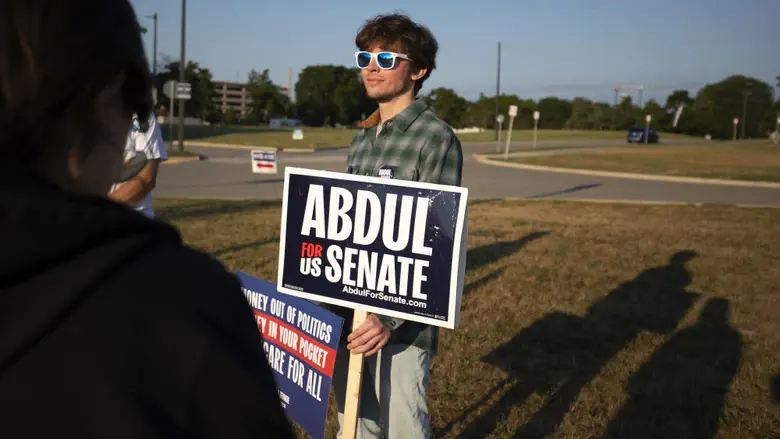
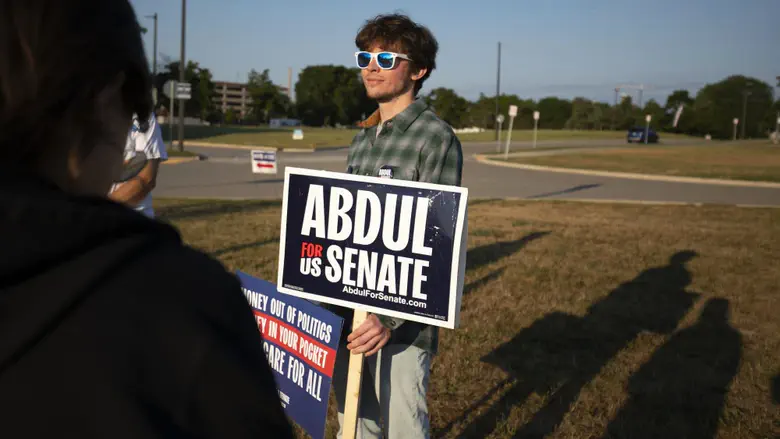
This dissonant mindset confronts us almost daily; for example, through the dogmatic partisanship of Jewish Democrats who support Michigan senatorial hopeful Abdul El-Sayed for the “greater good,” despite his history of provocative remarks concerning Jews and Israel and his association with antisemites like Hasan Piker. They cannot deny El-Sayed’s past rhetoric but argue nonetheless that Jews should sacrifice safety and self-interest in the service of progressive policies (e.g., unrestricted abortion, irreversible gender surgery for children, leftist economic policies) that are neither synonymous nor consistent with traditional Jewish values.
Even the Michigan Attorney General, a Jew who endorsed El-Sayed in September, continues to promote progressive candidates, reportedly saying that Jews have a “moral imperative to place the needs of the world above even our own self-interest and, yes, even our own survival.”
In what universe are such beliefs consistent with Jewish values – or even rational?
Such partisan delusions are clearly nonsensical, but they are also typical of highly politicized, secular liberals (and politically liberal clergy) who promote progressivism as the true expression of core Jewish beliefs, despite the left’s historical antipathy towards Jewish religion, culture, and national aspirations, and its embrace of antisemitic and anti-Israel ideologies and stereotypes.
Just as nonsensically, many of those who now concede the ubiquity of progressive antisemitism also engage in whataboutism, looking to assign equal or greater blame to mainstream Republicans and conservatives for the virulent antisemitism that has become de rigueur in American politics – especially among Democrats. Though there are certainly Jew-haters on the right, they are still considered fringe by establishment Republicans, unlike Democratic leaders who facilitated the rise of party radicals by embracing their agendas, tolerating their antisemitism by not shunning them for it, and turning against Israel.
Rather than admit their dysfunction, many Democrats minimize it by claiming that foundational Jew-hatred is far worse among conservatives and that more Jews on the right have historically been enablers of antisemitism. One of the more outrageous “proofs” of this assertion is the claim that 7,000 or so Jewish voters helped bring Hitler to power in 1932 – a contention for which no electoral records exist. Though a radical assimilationist organization known as the “Verband Nationaldeutscher Juden” (Association of German National Jews) did exist, it was an extremist fringe group that never had more than a few thousand members at its height, before being disbanded by the Gestapo.
Despite the internet popularity of this canard, it is transparently dubious for two reasons. First, Hitler was never elected (he lost the only election he ever ran) but rather was appointed chancellor of Germany by President Hindenburg. Second, it ignores the numerical disparity between a few thousand radical assimilationists in post-Weimar Germany, and the millions of American Jewish Democrats who continue to support a party that embraces progressive antisemites, and who themselves, in many instances, endorse elected Israel-hating radicals like El-Sayed, Rashida Tlaib, Ilhan Omar, Alexandria Ocasio Cortez, Bernie Sanders, and Zohran Mamdani (who brazenly hijacked the third anniversary of October 7th to falsely accuse Israel of “ongoing genocide” in Gaza).
But assuming for the sake of argument the unlikely claim that 7,000 Jews actually voted for Nazis in 1932, that number represented less than two percent of the total German Jewish population at the time, which was 525,000. This is a negligible percentage compared to the US today, where nearly seventy percent of an estimated 6,100,000 registered Jewish voters (approximately 4,200,000) continue to support a party that, by act or omission, homogenizes or validates hatred of Jews and Israel.
Thus, in contrast to the unverifiable assertion that a few thousand Jews supported Nazi candidates in Germany, there is concrete evidence showing significant tolerance or support among liberal Jews for progressive antisemites and anti-Zionists in the US today – reflected directly by their voting patterns or indirectly through their blind party loyalty. Rather than acknowledge the shameful implications of their electoral choices, however, they attempt to burnish themselves by toppling strawmen that have no empirical foundation.
And they do this out of the twin beliefs that Jewishness is synonymous with progressivism and that supporting the Democratic Party is a Jewish obligation – myths perpetuated by non-Orthodox movements and clergy who long ago replaced traditional observance with partisan politics. In truth, however, political agendas that belittle Jewish tradition and sanctify radical ideologies and cultural trends are inconsistent with Torah.
Indeed, conflating Jewish tradition with any secular political ideology – whether liberal, conservative, or somewhere in between – requires ignorance or dishonesty. And all the more so for progressive policies that contravene Torah, disparage traditional spirituality, and malign Jewish nationhood.
So how do the secular and politically acculturated among us promote such nonsense? By misconstruing or decontextualizing halakhic, mystical or historical concepts, and thrusting anachronistic political sensibilities backwards into Jewish history. It is somewhat ironic that, whereas they often eschew the faith traditions of their ancestors, they use the same kind of false didacticism employed by religious missionaries who seek to convert Jews by maintaining that Tanakh supports beliefs that contradict Torah law.
While rejecting traditional Judaism, they imbue progressive ideology with false spirituality by equating it with tikkun olam or musar, though misapplying these lofty concepts to mundane ideologies instead suggests Jewish illiteracy. Though defined as “social action” by the non-Orthodox movements, the term “tikkun olam” is derived from the Mishnaic phrase “mipnei tikkun ha-olam,” meaning “for the sake of the rectification of the world.” It refers not to politics, but to societal harmony through halakhic observance, particularly of those laws governing marriage and divorce, monetary restitution, the redemption of captives, and compassion for widows, orphans, and proselytes.
Kabbalistically, observance and prayer are seen as necessary for liberating divine sparks dispersed throughout the cosmos at creation, and for ingathering the souls containing these sparks to achieve spiritual tikkun (rectification).
True musar is likewise premised on traditional law and observance, not political ideologies extraneous to Torah. The purpose of musar is to “know wisdom and discipline, [and] to comprehend words of understanding” (Mishlei, 1:2), through Torah study, mitzvot observance, and personal reflection, which improve one’s piety, humility, and other middot (character traits). It is not intended to advance political goals – whether progressive or conservative.
By divorcing such concepts from their spiritual foundation and conflating them with political agendas, progressives attempt to sacralize the profane; and by doing so, to validate ideologies that contravene authentic Jewish tradition and portray antisemitic political compatriots as sincere critics whose aim is to stimulate Jewish introspection. But promoting ideologies that encourage hatred of Jews and Israel does not constitute self-reflection. It evidences ignorance, self-abnegation, or the compulsion to view Jew-hatred through the lens of moral equivalence.
It also evokes moral blindness, which seemed apparent when nearly 200 Jewish artists and academics signed an open letter defending actor Mark Ruffalo against accusations of antisemitism arising from his very public (and ignorant) diatribes regarding Israel and Gaza. However, if one consistently mischaracterizes Israeli action in Gaza as genocide (it is not) but ignores real genocides occurring elsewhere in the world (e.g., Darfur, China, Myanmar), hateful intent can certainly be inferred and should never be defended.
Unfortunately, progressives often pontificate that reasonable minds can disagree on the issue of genocide in Gaza. Even according to the morally vacuous UN, however, genocide requires “intent to physically destroy a national, ethnical, racial or religious group.” The unimpeded growth of the Gaza population (which has more than quintupled since 1967 and remained stable since 2023) alone undercuts any claims of genocide, though such slanders persist.
The only possible explanations for this modern blood libel are ignorance or hatred. So, no; reasonable minds cannot disagree.
The philosophical dilemma for liberals is the belief that progressivism is an intrinsic Jewish value, and that surging leftist antisemitism must therefore be a reaction to bad Jewish behavior. Such addled thinking, however, stems from the sanctification of political beliefs that are fundamentally infused with Jew-hatred, and which necessarily require the suspension of faith in Jewish scripture, law, and history.
It could thus be argued that those who embrace political agendas that contradict Jewish law and tradition become like the “kofer ba’ikar,” or “one who [heretically] denies the essence [of faith].” Accordingly, those who elevate politics over Torah and Jewish history are crossing a spiritual Rubicon from which return may be impossible.
Source link