France’s growing internal tensions, the safety of its Jewish community and the failures of its political leadership were at the center of a sharply critical edition of The Israeli Perspective, in which host Jay Shapiro accused President Emmanuel Macron of allowing the country’s professed commitment to liberty and equality to become disconnected from the reality on its streets.
Shapiro described a France in which violent demonstrations, attacks on Jewish institutions and mounting political polarization have exposed what he considers a fundamental failure of government. He argued that French Jews are increasingly being made to bear the consequences of political disputes in which they have no direct involvement, particularly the conflict between Israel and the Palestinians.
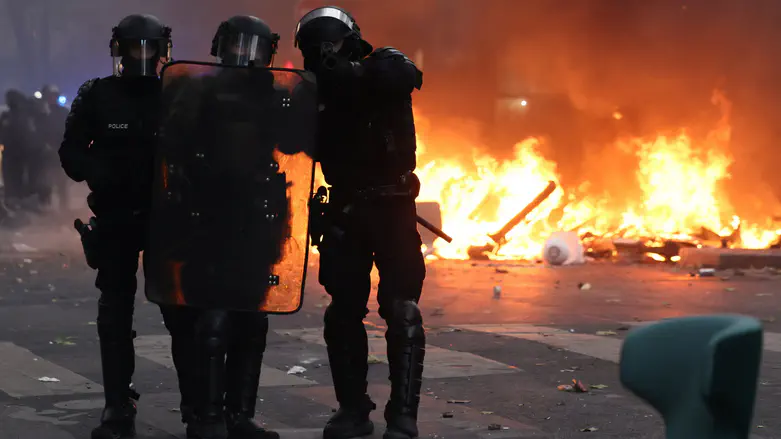
“France likes to speak of itself as being the main line of liberty and equality and fraternity,” Shapiro said, invoking the French Republic’s historic motto. “But right now the streets in Paris and other cities are burning and stores are being looted.”
For Shapiro, however, the most troubling aspect of the unrest is not the destruction of property or the inability of authorities to maintain order. It is the vulnerability of French Jews, whom he believes have become targets of hostility under the cover of political protest.
He pointed to reports of vandalism at a synagogue in Paris’s 19th arrondissement, where, according to his account, the Torah ark was forced open and religious objects were thrown onto the floor.
There could be no legitimate connection, he argued, between public frustration over living costs or educational conditions and attacks on Jewish religious institutions.
“There is no moral path leading from student hardship or lack of food to attacks on Jews,” he said.
Shapiro acknowledged that economic difficulties can generate legitimate public anger and that demonstrators should not all be treated as responsible for violence. But he argued that protests lose their legitimacy when they become vehicles for antisemitic intimidation, arson and attacks on police officers.
He was particularly critical of the appearance of Palestinian flags and pro-Palestinian slogans at demonstrations, which he interpreted as evidence that some participants had redirected their anger toward Israel and, by extension, toward French Jews.
In his assessment, this reflects a broader and recurring problem: Jewish citizens of European countries are being treated as though they must answer personally for the decisions of the Israeli government and military.
“Once again, French Jews are expected to answer for the problems and actions of the IDF and Israeli government,” he said.
The historical implications are especially disturbing, Shapiro argued, recalling both the Dreyfus affair at the end of the 19th century and the persecution of Jews under France’s Vichy regime during World War II.
He cited a figure of 1,320 antisemitic acts recorded in France in 2025 and referred to additional attacks on Jewish institutions. These figures and incidents were presented during the podcast but were not independently verified for this article.
Shapiro also raised concerns about Islamist extremism and the integration of Muslim communities into French society. Citing a survey he attributed to 2025, he said that 44% of Muslim respondents placed religious rules above French law.
He argued that the French government must defend the authority of its laws while protecting both Jewish citizens and moderate Muslims. He explicitly acknowledged that many Muslims are moderate and should not be identified with extremist movements.
His broader accusation was directed at political leaders who, in his view, have allowed electoral considerations to weaken their response to extremism.
“In France, as well as in Britain, politicians fear losing the Muslim electorate,” he asserted.
Shapiro placed particular responsibility on Macron, whose presidency he characterized as a failure to reconcile France’s international moral rhetoric with the government’s obligations toward its own citizens.
“This president in France, Macron, I think will be remembered very negatively,” he said.
His criticism extended beyond the present unrest to France’s historical relationship with Israel.
Recalling the period immediately preceding the Six-Day War in 1967, Shapiro pointed to France’s arms embargo against Israel and its refusal to deliver Mirage fighter aircraft that Israel had ordered.
He described the decision as a betrayal by a major military supplier at a moment when Israel faced serious security threats.
For Shapiro, the episode demonstrated the limitations of international assurances and the risks of relying on foreign governments whose political interests may change.
He also invoked France’s colonial history, mentioning the repression of independence movements in Algeria and Madagascar, along with the killing of African soldiers by French forces in Senegal in December 1944.
These episodes, he argued, undermine the moral authority with which French leaders criticize other nations.
Shapiro drew on commentary by Israeli broadcaster David Ben-Bassat and quoted a monologue he attributed to French philosopher Martin Boudry, which portrayed Europe’s treatment of Jews and Israel as part of a wider failure to confront extremism.
One passage particularly captured the argument Shapiro sought to convey:
“Before long, we will all know what it feels like to be Jewish. In France, they already know.”
The quotation was presented by Shapiro as part of another writer’s commentary, rather than as his own original statement.
The implications of the situation in France, he continued, are already being felt in Israel.
Drawing on his own experiences visiting France, Shapiro recalled neighborhoods in Paris where he said he had felt uncomfortable walking. He connected those memories to his concerns about the growth of antisemitism and the future of Jewish communities in the country.
He also pointed to immigration from France to Israel, noting that French-speaking communities have become increasingly visible in several Israeli cities.
“There are several places in Israel right now where French is the language of the street, and that’s because of the anti-Semitism in France,” he said.
Shapiro cited remarks attributed to Professor Cyril Cohen of Bar-Ilan University, who reportedly suggested that political polarization in France could accelerate Jewish immigration to Israel regardless of which political camp prevails.
“Whether the right or the left wins, there is likely to be a wave of Aliyah from France,” Shapiro quoted him as saying.
According to the account presented in the podcast, Israeli universities, including Bar-Ilan, are already absorbing increasing numbers of French-speaking students.
Shapiro also referred to a political cartoon depicting French Jews considering whether to choose Jerusalem or Netanya rather than deciding between rival political candidates, an illustration of the anxiety he believes is shaping their future.
The discussion led him to reflect on political divisions within Israel itself.
He criticized Israelis who threaten to leave the country if election results do not align with their political preferences, arguing that the experience of Jewish communities abroad should serve as a warning against assuming that other countries necessarily offer security.
“I would suggest that all these people keep in mind that there is no guarantee of a safe haven and a warm welcome for Jews anywhere today, no matter what camp they belong to,” he said.
Shapiro also warned of attempts by foreign powers, including Iran, Russia, Turkey and Qatar, to exploit internal divisions in Israeli society. He described such interference as part of a broader effort to weaken the Jewish state, though he did not present specific evidence of individual operations during the episode.
His observations about France and European antisemitism eventually led to a second major subject: what he considers the shortcomings of Israeli public diplomacy.
Shapiro argued that the repeated demand for better hasbara, the Hebrew term commonly translated as public diplomacy, has become an inadequate response to the challenges Israel faces internationally.
In his view, Israeli politicians and public figures frequently criticize the country’s messaging without identifying the substantive arguments that should replace it.
“The fact is that 25 years of Oslo-era diplomacy and Hasbara have not worked,” he said.
The problem, he suggested, is not simply that Israel has failed to communicate effectively. Rather, he believes it has relied too heavily on arguments framed around immediate security concerns, diplomatic concessions and appeals for international sympathy.
He called for a fundamental change in the substance of Israel’s international message.
“The first is making Israel’s public diplomacy Jewish,” Shapiro said.
He argued that the Jewish people’s historical and religious connection to the Land of Israel should occupy a central place in the country’s diplomatic narrative, including its claims regarding Jerusalem, Judea and Samaria.
According to Shapiro, secular Israeli leaders and diplomats have traditionally emphasized arguments they considered more accessible to international audiences. But he maintained that distancing Israel’s case from Jewish history and identity has weakened its legitimacy rather than strengthened it.
Instead, he called for a narrative that presents Israel as the expression of a continuing relationship between Jewish faith, peoplehood and territory.
“We have to speak about history, justice, and the Jewish nation,” he said.
To illustrate his point, Shapiro referred to observations by Jerusalem Post columnist David Weinberg following visits to Dubai and Abu Dhabi.
According to Shapiro’s account of Weinberg’s writing, some Emiratis expressed respect for Israelis precisely because of their attachment to Jewish tradition, historical continuity and national identity.
Shapiro suggested that Israel should embrace those qualities rather than minimize them for diplomatic convenience.
His proposed change in messaging, however, extends well beyond questions of religious and historical identity.
He argued that Israel must also communicate its military strength without embarrassment or apology.
“Israel’s messaging must affirm Israel’s power,” he said. “We have to articulate our strength.”
Shapiro described Israeli military operations and security policies as part of an effort to reshape the regional strategic environment and establish more defensible borders.
He referred specifically to Gaza, Lebanon and Syria, asserting that Israel was changing its security arrangements along those frontiers in response to the threats it faces.
“The borders of Israel are going to be very different now than they were three years ago,” he predicted.
These were Shapiro’s assessments of Israeli policy and its likely direction, not established descriptions of internationally recognized border changes.
He argued that advocates of Israel should be prepared to explain such measures as security necessities rather than retreat from defending them under international criticism.
To reinforce his argument, Shapiro recalled an observation he attributed to Israel’s first prime minister, David Ben-Gurion, about the biblical vision of a future era of peace.
According to Shapiro’s retelling, Ben-Gurion welcomed the prospect of a world in which predators and their prey could live peacefully together, provided Israel remained the stronger animal.
“Israel must be the lion,” Shapiro declared.
His insistence on military strength was also personal.
He spoke about his grandchildren serving extended periods of reserve duty in the Israel Defense Forces and recalled a recent telephone conversation with one grandson stationed in Lebanon.
“Right now, my own grandchildren are spending days upon days in the military, in the reserve duty,” he said.
The personal account illustrated the connection Shapiro draws between national security policy and the experiences of Israeli families whose relatives continue to serve in the military.
He also argued that Israel must abandon diplomatic language that obscures its actual positions on territorial and political disputes.
In particular, he rejected the description of Judea and Samaria as occupied territory, basing his position on the Jewish people’s historical connection to the region. That position is contested internationally, and the podcast presented Shapiro’s argument rather than a legal analysis of the territories’ status.
Shapiro was similarly dismissive of the prospects for a two-state solution.
“The two-state solution does not exist,” he stated.
He argued that past diplomatic efforts had failed and that Palestinian political leadership could not currently be trusted to establish a state that would coexist peacefully with Israel.
He suggested that prolonged Israeli security control, combined with eventual cooperation, might offer an alternative framework for future relations. He did not outline a detailed political arrangement or timetable.
Shapiro also criticized Israeli attempts to counter international boycotts, sanctions and accusations of war crimes or genocide primarily through explanations of military conduct.
He maintained that Israel should not limit its public diplomacy to defending individual operations or responding to accusations, but should articulate its underlying political, historical and strategic positions more assertively.
The approach he advocated would place Jewish national identity, historical claims, military deterrence and skepticism toward Palestinian statehood at the center of Israeli messaging.
It would also require Israeli representatives to defend positions that many foreign governments reject, rather than tailoring their arguments solely to seek broader international approval.
Throughout the episode, Shapiro repeatedly returned to his conviction that Jewish security cannot depend on the goodwill of other governments.
France, in his account, provides an example of the dangers of relying on declarations of tolerance that are not matched by effective protection. Israel, by contrast, must preserve both the capacity and the willingness to defend itself.
He made no prediction about when the country’s security challenges might be resolved, acknowledging uncertainty about the future.
“It is a difficult situation,” Shapiro said. “I don’t see how it’s ending. I don’t know if it will end in my lifetime. But we have to defend what we have and who we are without having to apologize to anybody.”
Source link