Giulio Meotti is an Italian journalist with Il Foglio and fellow at the Middle East Forum. He writes a twice-weekly column for Arutz Sheva. He is the author, in English, of the book “A New Shoah”, that researched the personal stories of Israel’s terror victims, published by Encounter and of “J’Accuse: the Vatican Against Israel” published by Mantua Books, in addition to books in Italian. His writing has appeared in publications, such as the Wall Street Journal, Gatestone, Frontpage and Commentary.
The Alliance of Democracies conducts an annual study called the “Democracy Perception Index.” The latest report finds that “Israel is the most unpopular country in the world,” with a favorability rating lower even than that of gulag-era North Korea and Taliban-ruled Afghanistan. It is not only Benjamin Netanyahu, the bête noire of the international intelligentsia and “a pain in the ass,” as Barack Obama once called him. As curator Milana Gitzin-Adiram puts it, “in many places we are simply persona non grata, almost Satan.” Iran’s Little Satan.
A few days ago Luxembourg decided it no longer wanted to be the country responsible for approving Israel Bonds issuances in the European Union. This is the organization that handles the sale of Israeli government bonds to diaspora Jews (a business worth €2.5 billion a year). A low blow, given that Luxembourg had only taken on the role a year earlier, after Ireland had given it up.
Yet in the World Happiness Index the Jewish state ranks ahead of Luxembourg, the tax haven that last saw war on 10 May 1940 during the Nazi invasion (Israel contrasts with other war-ravaged countries that are understandably unhappy, such as Ukraine in 111th place and Lebanon second-to-last in 145th).
Shuki Friedman, head of the Jewish People Policy Institute, tracks sanctions imposed on Israel through a world map that is growing ever more crowded. His database records 110 sanctions currently in force, applied by 54 countries. The only continent that currently imposes no sanctions on Israel is Antarctica. This is the price of military victory, Bibi or not Bibi. The image that has been pushed of Israel in the West is that of an anti-democratic, dark country on the brink of “suicide”.
Reality says the exact opposite.
While over the past twenty years Israel has held nine parliamentary elections, no elections have been held in the Palestinian Arab territories of the ‘West Bank’ and Gaza since 2006 (and no neighbor of Israel holds free and democratic elections). Among two hundred countries in the world, Israel ranks among the twenty longest-lived continuous electoral democracies.
After gaining independence in 1948, Israel has maintained its parliamentary democracy for 78 years. Israelis like to vote (78 percent turnout, compared with 63 percent in Italy). Since 1996, elections have been held in Israel every two or three years (six elections since 2019), a shorter interval than that found in twenty other democracies examined: higher frequency than Spain (3), Japan (3), Canada (3.2), the United Kingdom (3.8) and Italy (4.4), among others. A young country with a strong democratic tradition.
And Israel has once again demonstrated that it is the worst apartheid regime in the history of apartheid: no Arab country in the world allows Arabs to vote freely as happens in Israel, where Arab parties have doubled their seats (and with their success effectively prevented the creation of an automatic political majority).
In the famous Democracy Index, published annually by The Economist, Israel ranks thirtieth: four places ahead of the United States and seven ahead of Italy.
In “The Genius of Israel: The Surprising Resilience of a Divided Nation in a Turbulent World,” the new book by Dan Senor and Saul Singer, authors of “Start-Up Nation,” Israel is “Morningburg,” while Europe is “Twilight City.”
According to the Pew Research Center, Israel and Singapore are the only rich countries in which more people are optimistic about the financial future of their children than their parents. Across nineteen countries, the average who answer “worse” is seventy percent; in Israel only 27 percent (the least pessimistic). During the pandemic (2019-2022), pessimists decreased in Israel, while elsewhere they rose to record levels. The country is both younger and longer-lived, more quarrelsome and more cohesive, more exposed to death and more resistant to despair. Israel is the anthropological anomaly that challenges the maps of hatred and the geographies of well-being.
Take the so-called “deaths of despair” (suicides, drugs, alcohol): Israel has the lowest rate among OECD nations. Sweden, Denmark and Norway have rates two to three times higher. Israeli men have the fourth-highest life expectancy in the world, women the eighth. Adolescent suicides, although each is mourned deeply, effectively do not exist in the country: among the lowest in the world, less than a third of the OECD average and less than a quarter of the United States, Australia, Finland and Canada.
Despite isolation and war, Israel remains firmly in eighth place in the World Happiness ranking (it was even fourth before the mourning after October 7). Israel is the anomaly among the happiest nations. Geographically, the countries ranked from first to ninth are all located in a tight circle centered on Copenhagen: Finland, Sweden, Denmark, Norway, Iceland, the Netherlands, Luxembourg and Switzerland. Peaceful, quiet, politically stable countries with generous welfare systems, where the food is bad and the weather is terrible.
Then there is Israel, far away in the Middle East, a region not exactly known for tranquility. Noisy and quarrelsome Israelis rate their lives as more satisfying than Swedes, Swiss, Americans, Australians, Canadians, Italians and Singaporeans. Israel ranks first in the world for the number of living kidney donations (including altruistic ones) per capita, a result largely due to the Matnat Chaim organization in Jerusalem.
Compared with a West that looks backward with nostalgia and forward with pessimism, the Bank of Israel forecasts say the Jewish state’s economy will grow by 5.6 percent in 2026 and by 7.5 percent in 2027. The country will be called upon to make difficult and strategic choices, from accelerating military self-sufficiency from the United States to an industrialization that abandons European partnerships for anti-Chinese Asian alliances and anti-Iranian Arab ones (since October 7, Israeli tech companies have lost 8,500 employees due to emigration).
Meanwhile, Israel is third in the world in the startup ranking (Global Startup Ecosystem Index 2026), is the country with the highest score worldwide for “quality of social relations” (the country is united, a crucial factor for overall well-being), ranks tenth for the number of Nobel Prizes won (in per capita terms it surpasses the United States, Germany, France, Canada and Japan), fourth in the world for scientific publications, sixth in the World Index of Healthcare Innovation (Israel conceived itself as a nation that could, as Arieh Herzog, former head of Israel’s missile defense agency, said, “innovate or disappear”), fifth for the number of patents per capita (after Japan, Sweden, Switzerland and South Korea, all countries not at war) and –
Nowhere else among developed countries are so many children born as in the Jewish state (and by 2050 it is projected that Israel will be twenty years younger than Italy, Spain and Germany).
Despite the Second Intifada, the wars in Gaza and October 7, the net migration balance is 480,094 people who have arrived in Israel from all over the world from 2000 to today.
Meanwhile the Israeli region on the border with Gaza, known as “Tekuma” (rebirth), has grown by ten percent compared with the situation prior to the October 7, 2023 attack. What other people with Western customs would return en masse to live where just three years ago more than twelve hundred of their fellow citizens were murdered in medieval scenes?
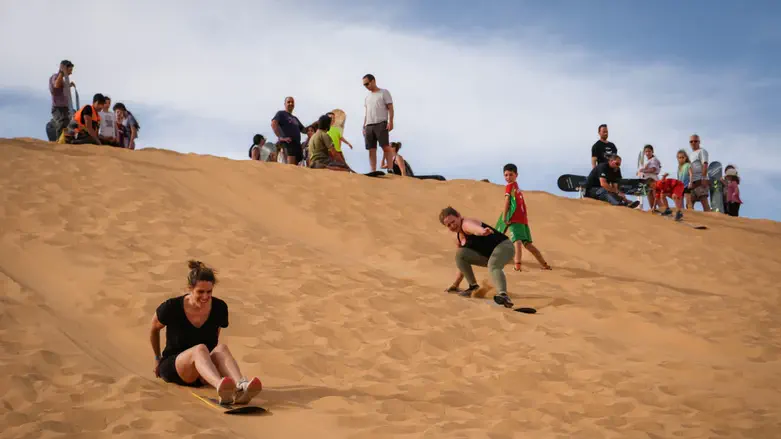
The Little Satan laughs happily, because it has learned not to confuse unpopularity with defeat and has taught the world that one can live very well even at the foot of a volcano.
Source link