
It can be said: We love whale song, whether because terrestrial apes are biologically prone to mellowing when hearing a water animal speaking or thanks to marketing. Fact is, you can find “whale song meditation music” on Amazon and a 10-hour “Whales for Sleep” playlist on Spotify for the insomniac and credulous, even though there is no proof that cetacean vocalization affects us monkeys biologically more than any other vibrations.
In any case, whales are not singing for the benefit of primates but to communicate with each other. Their sounds are designed to travel long distances in the water but after millions of years of evolving to achieve that, in the last century and a half, the conditions have changed. The screeches and bangs and thumping engine noises made by ships inevitably overlap in frequency with marine animal sounds.
Indeed it does seem that long-finned pilot whales (Globicephala melas) in the Straits of Gibraltar are having trouble hearing each other, Milou Hegeman and Frants Jensen of Aarhus University, Denmark and an international team of colleagues reported on Wednesday in the Journal of Experimental Biology.
How are the whales in this subpopulation competing with the sounds of around 60,000 ships a year sailing the strait? By shouting to make themselves heard over the anthropogenic racket, insofar as they can.

The long-finned pilot whale is critically endangered. Being audible is especially important to it.
“They are highly social, matrilineal animals that live with the same social group for most of their life. In the Strait of Gibraltar, many of their dives are synchronized and this helps decrease the risk of separations, but they still get separated occasionally when some individuals stay at surface or if they get too far away from each other during a dive,” Jensen tells Haaretz by email.
But not all sounds they emit can be cranked up and worse, their keenest need to call loudly is to regroup with their pod on the surface after diving deep in search of food, but in dense vessel traffic, their calls may not be loud enough to be heard over the din. The rising background noise essentially decreases the effective communication range, making it harder for distant animals to find each other, Jensen says.
Can they get lost at sea? “I don’t think they really become completely lost – eventually, when noise passes, they can hear each other again,” he answers. “But it is likely that prolonged noise can affect how long time they spend searching for their group rather than foraging, and this can impact survival and reproduction, and make the population less resilient to other stressors such as severe disease outbreaks.”

Beyond Moby Dick
Whales weren’t always public darlings. They were assiduously hunted and the reading public applauded the murderous quest for a white whale. Since then, the giants of the sea have won our hearts. Whale song captivated us as soon as we realized what those strange moans from the oceans were, which was in the early 20th century. Now on Spotify we find “Whales for Sleep,” a playlist of whale emanations to help insomniac subscribers forget their cares. There are whale watching cruises to areas where whales are expected to be, which are defended as promoting the animals’ profile and cause but have been demonstrated to disturb them.
The bottom line is that intentions may be good but between whale watching and the cruising industry and international trade, we are polluting the oceans with noise; we also know the noise disrupts animals’ behavior. Here Jensen and the team set out to study the impact on the long-finned pilot whale in the Strait specifically because it is small in area and heavy in human traffic.
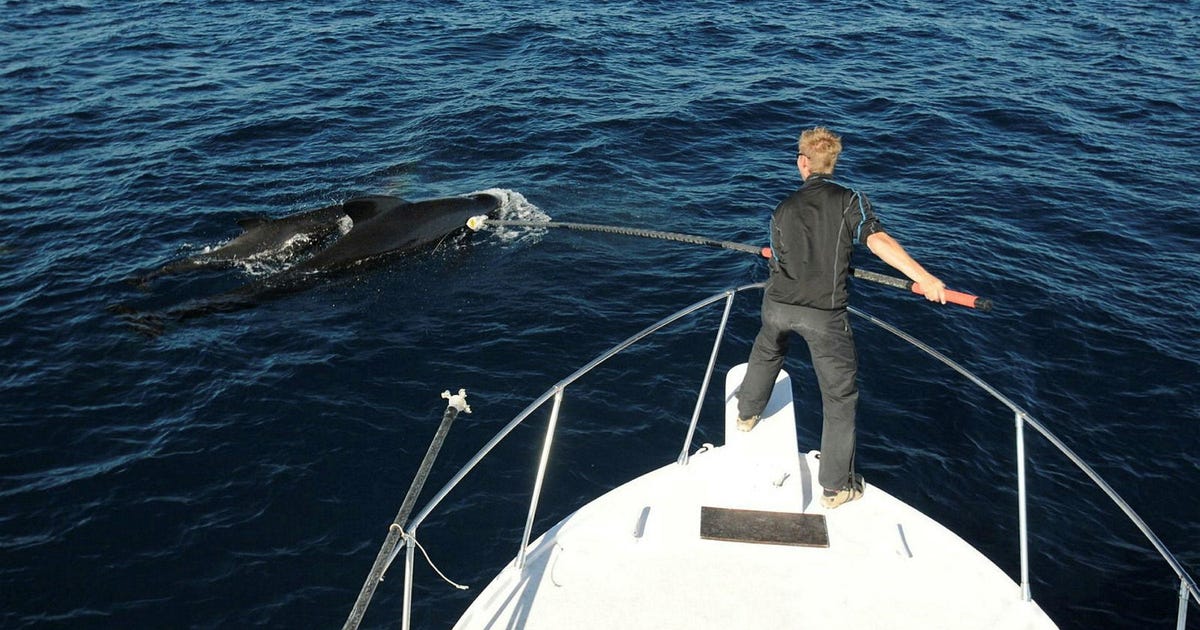
From 2012 to 2015, the team recorded pilot whale calls and the background noise. How? They used a 6-meter-long pole to attach recorders with suction cups to the backs of 23 pilot whales, the Journal explains in a press release. These measured the animals’ movement and depth and recorded the sounds in the water before popping off and floating to the surface 24 hours later.
Back in the lab, the team laboriously matched each call to a whale and checked whether they could identify what the whales were doing based on their calls. They did indeed divide 1,432 recorded calls into four categories: short, pulsed calls, high-frequency calls and for long distance, low-frequency and two-component calls.

And in the background, the recorders caught noise that ranged from 79 to 144 decibels. That is like standing next to a vacuum cleaner in a noisy restaurant, the Journal observed.
How did they cope? Like we would: by shouting compared with their normal vocalization volume, the team found.
But they can’t ramp up the volume of all their repertoire of calls. The quieter calls, the high-frequency and short pulsed calls, can be amped up enough to overcome the noise. But the pilot whales are already shouting as loud as they can when making their low-frequency and two-component calls, when searching for one and other after diving deep for food. They can’t shout any louder, the team reports.

It is the cetacean expression of the “Lombard effect,” an unwitting effort to speak louder and enunciate more clearly in a noisy environment. That is in we lingual beasts; the volume principle applies however throughout the animal kingdom, from the lowest amphibian to the loftiest primate. When beset by noise, we employ vocal plasticity. Great tits do chirp louder in noisy cities than in the country, it has been found.
The new paper points out that Lombard mitigation ability apparently varies from species to species; some work suggests near-complete vocal compensation in beluga whales, orcas, and right whales but when we get to humpbacks, minkes and dolphins, the response seems more partial. In the pilot whale, it’s partial.
Thus the noise we make at sea adds to the whales’ other existential worries, including chemical pollution, habitat degradation, climate change, death by human (intentionally by hunters or when they get accidentally caught in nets), and getting slammed by boats.
Worse, the noise pollution disturbs more than their calls to mate. Separate work has demonstrated that disrupted communication in noisy environments can reduce learning between mother and calf, disrupt foraging and of course affect cooperation.
What do we learn? That the pilot whales of the Strait have to shriek to hear each other and it may not work because the Lombard response can apply up to the point of physiological constraint. Mainly we learn that we need to better understand how our noise impacts marine life, because for the critically endangered pilot whale subpopulation in the Strait of Gibraltar, the team sums up – they probably can’t shout loud enough to maintain effective long-distance communication.

Can these results be extrapolated to other cetaceans? Yes, in fact to all animals, according to the scientist.
“Yes, if noise overlaps in time and frequency with animal communication signals, it can prevent detection and decrease the effective communication range, and this is true for all animals,” Jensen says.
“Cetaceans have evolved to depend extensively on sound because sound travels far underwater and because vision is not a good modality, so we are particularly concerned about noise effects on cetaceans.”
Apropos online whale songs for the sleepless, it couldn’t hurt, though if you’re listening on the internet, unless you have a subscription you’ll likely be startled back into wakefulness by ads. But fret not. In the age of targeted advertising, you will probably be regaled with promotions for CDs of whale songs to help you sleep.