
Fungi are all around us, all the time – spreading their network of filaments in silence over vast spaces, beneath the soil; sprouting in foggy conditions and launching their reproductive spores, which swirl about in the air and wait patiently for an encounter with an appropriate host. They nest in the foods we consume and they break down waste. Without them, planet Earth and everything upon its surface would drown in dead organic matter.
Trees and plants owe their growth to fungi and are dependent on their assistance to recover from catastrophic events including extreme climatic episodes. When they need to, for their own purposes, fungi are even capable of controlling creatures that have a brain and of altering their natural behavior. They exploit their vital role in cycles of life while activating sophisticated mechanisms that almost seem to possess human intelligence and consciousness.
Even though they were here long before us, and indeed before the majority of land-based creatures, it wasn’t until about five years ago that international environmental organizations at last acknowledged that fungi deserve a category of their own. Neither animal nor vegetable, but a new, third framework: Kingdom Fungi.
Of the many millions of different species of fungi, science has to date identified and classified only about 150,000. This is a mysterious promised land, which fires the imagination and impels the armies dealing with human knowledge to conquer it.
In recent years, scientists have been developing fungi that will replace plastic and will be able to act as a covering and as insulation in the construction industry. Other types can substitute as leather in the fashion industry. Fungi are also being recruited as chemical warriors against agricultural damage; as meat substitutes in the food industry; as agents in a psychiatric revolution that will aid sufferers of depression; and as raw materials for sustainable objects, which after use can be used in soil reclamation, without any investment of energy.
Ancient, traditional knowledge developed over multiple eras is today emerging from forest and field, making its way into laboratories and industries as part of a process of recruiting the denizens of the third kingdom – i.e., microorganisms such as fungi – in the service of the ruling species: human beings.
Last month, at an investment of over $1 million, Israel’s Shamir Research Institute, in the Golan Heights town of Katzrin, established PITRIOT: The National Center for Mycology (the study of fungi).
“We are laying the foundations here for production of innovative medication for mental health purposes,” says Prof. Eyal Kurzbaum, who heads the environmental biotechnology lab at the institute and is heading its research into psychoactive fungi.

In a special facility for extracting psilocybin – the hallucinogenic substance found in numerous species of fungi – Kurzbaum cautiously explains the operating mechanism of the substance, seeking to channel the discourse away from irrational interpretations. “I am not one of those people who will talk about how mushrooms are trying to tell the human race something that we must listen to, because nature created them in order to improve the society of man,” he says.
Instead, he provides a scientific explanation: Psilocybin, the active substance in the fungus, binds to serotonin receptors in the brain that are involved in regulating mood, sleep and appetite. The binding process temporarily alters patterns of neural activity – hence the psychedelic experience.
Scientists see the process as a “neurobiological window” in which thought patterns slacken. Therapists believe that in this state, there is facilitated access to the subconscious – that is, a direct path to unraveling psychological and behavioral fixations. Alternatively, the experience can serve as a point of departure for therapy sessions in the immediate period after psilocybin is ingested. Psychoactive substances derived from fungi are also being tested today for treating degenerative manifestations of the brain, such as Alzheimer’s.
According to Kurzbaum, research studies have shown that psilocybin can be effective in treating a variety of addictions – alcohol, nicotine – and disorders including anorexia, depression and posttraumatic stress, as well as being a substitute for chronic medicinal treatments. Indeed, the hope is that “mycological treatment” will replace “medicinal treatment” and become a substitute for prolonged psychoanalytical processes. What it boils down to is the possibility that in the future, a patient will not need such therapeutic treatment at all, or will only need it on an every-few-months basis.
All this does not particularly encourage traditional Western industries – especially the thriving pharmaceutical industry – to support research and development of so-called mycological pharma. “The stumbling blocks are perceptual,” Kurzbaum explains. “We have to transform something frightening, which was considered marginal and dangerous, into a medical product that is purchased in drugstores or taken in the therapist’s clinic.”
In Israel, the fungi that contain psilocybin are classified by health authorities along with heroin and cocaine – the most hazardous and addictive of drugs, devoid of any medical benefit. But Kurzbaum argues that it should be moved from that blacklist: “We know that people have been partaking of substances like this for thousands of years. To cause death, more than 30 kilos needs to be ingested at one time, and they’re not addictive. The hippie generation that used such substances in the 1960s and ’70s didn’t become the junkie generation. The barrier is more cultural than medical.”
At the Shamir Research Institute an effort is underway to make order of the sometimes misleading information on the subject that informs amateurs, researchers and academic labs alike. A “national fungi bank” is also being established here to serve as a center for growing different species and analyzing their attributes in terms of practical applications. The institute’s CEO, Dina Gilad, entertains a vision of the Golan Heights as Israel’s “mushroom valley.” One-third of the activity of the 120 researchers and laboratory staff on site will be dedicated to research and innovation in this field.

Hadas Sibony Benyamini, director of the mycology center, notes that the fungi-based product market is growing globally at a rate of 10 percent a year, such that by the end of the decade it will be worth over $100 billion.
“We are still far from mapping the total potential of even the species that have already been identified – and they are only a small part of the vast kingdom, most of which is still hidden from sight. The possibilities are immense,” Dr. Sibony Benyamini says. “Truly great and important things are awaiting us here, below the ground.”
Fungus vs. mushroom
This is the place to note that what we know as the mushroom as it appears in children’s books, for example, is only the fruiting body, the reproductive structure, or the “flower,” of the fungus. In other words, the “mushroom” we see is the aboveground, short-lived tip of an organism. The complete fungus is actually located underground and looks like a tangled net of thin filaments, known as mycelium. An encounter between two such filaments gives rise to what peeks out above the surface – albeit only in suitable environmental conditions.
Those conditions are the focus of studies by Nitsan Bar-Shmuel, field coordinator of the national fungi bank in Katzrin and project manager of the Wild Mushroom Monitoring Project in Israel. She is unhappy about what she sees as the binary attitude people have toward the object of her research.
“People ask whether you can eat it or whether it’s toxic – and that’s it,” she says. “Fungi constitute a much more complex world than those two culinary poles. They are agents of environmental change: They determine which plants will thrive, they break down substances that interfere with growth and spread toxins that distance and eliminate subterranean enemies. They are the largest chemical warfare army in the world; they influence the accumulation of carbon in the soil and as such determine the response of the environment to climatic changes.”
In the past, researchers of fungi often depended on nature to provide a clue, in the form of a small “hat” that cropped up amid the weeds, or a colorful protrusion from a tree trunk. Today scientists bring a bit of soil into the lab and discover what can grow from it.
A large number of fungi don’t produce external fruiting bodies; their mycelium frequently extends across extensive areas and exists for many years, but underground. Thus, what look like separate mushrooms that have sprung up at a distance from one another might often be fruiting bodies belonging to a large-scale, long-entrenched, subterranean organism. For example, in the state of Oregon, a fungus of the Armillaria type was found to extend across about 9 square kilometers (about 3.5 sq. miles). Such a “humongous fungus,” however, is an extreme example. More frequently, mycelium is found to cover dozens of meters, and only at certain times of year, if at all, do they reveal their existence to the human eye.
For his part, Kurzbaum is focusing on producing psilocybin from mycelium, because a uniform, homogeneous substance can be extracted from it, as opposed to from the fruiting body, in which there are enormous differences between each species. And sometimes there are also surprises. In nature a fungus generates psilocybin in order to survive; it’s a secondary substance used for purposes that have yet to be unidentified, as of now. Certain species respond to cultivation under the pampering conditions of the lab by reducing production of the substance. It follows that in order to achieve results it will be necessary to make things tough for the fungus by creating artificial conditions of distress.
“Our monthly harvest is enough for between 1,000 and 1,500 ‘trips’,” we are told at PsygaBio, whose website describes it as “a drug discovery company focused on developing groundbreaking therapeutics derived from natural compounds.” Housed in a generic glass building in Or Akiva, between Tel Aviv and Haifa, PsygaBio is a carefully guarded facility where a pilot project is underway to extract psychoactive substances from fungi. The goal: to achieve large-scale production for use in clinical experiments in Israel. A visitor is asked to leave their bags outside, so nothing will be taken “by mistake.”
Here, psilocybin is still extracted from the fruiting body (aka mushroom) of the fungus as part of an operation headed by biochemist David Meiri of the Technion – Israel Institute of Technology in Haifa. Active in the field of medical cannabis, among other pursuits, Prof. Meiri received special permission to import to Israel 250 different species of fungi that naturally produce psilocybin, for research purposes.
The spores begin their journey in petri dishes and the mycelium grows in test tubes and is moved to soil in plastic boxes, where the fungus consumes the nutrients it is served. From them the “caps” sprout in different shapes and colors. Within three months they mature and are harvested. At this stage it is already possible to see the telltale signs familiar to the researchers: the blueish color that becomes visible when the mushroom’s fleshy “leg,” or stem, is cut open, revealing the psilocybin that has accumulated. A light squeeze deepens the color, which spreads across the flesh of the mushroom. The darker the color, the larger the concentration of the active substance, which is then fully extracted, dried and stored in capsules.
“The aim is to very carefully select the outstanding species,” Dr. Yaniv Lerenthal, CEO and vice president of R&D at PsygaBio says. In other words, to take mushrooms that are easily grown – with a stable growth cycle, which sprout and flower together, and with the highest uniform concentration as possible of the active substance – to be cultivated by means of hybridization in the lab.
Concurrently, the Institute for Psychedelic Research at Tel Aviv University has launched clinical experiments on the effects of psilocybin. So far, they have only involved a few volunteers, whose number can be counted on the fingers of one hand. The experiments, conducted at Tel Aviv’s Ichilov Hospital and led by neuroscientist and psychiatrist Talma Hendler, who heads the institute, are accompanied by psychoanalytic therapy.
At this stage, synthetic psilocybin manufactured in the lab of a Canadian company is being used. “Psilocybin works – that’s already clear,” Prof. Hendler says. “The question is how it works. That, among other things, is being examined via MRI brain scans.”
She adds that synthetic psilocybin is quite easy to manufacture, so the pharma industry tends to prefer it for practical reasons. At the same time, some researchers think that there are significant differences of influence between synthetic psilocybin and the substance that derives from the natural flesh of a fresh mushroom.
PsygaBio staff estimates that the final cost of a mycological capsule will be a few hundred dollars. If that sounds steep, it’s worth remembering that the idea is, in essence, for a psychedelic trip to replace years-long treatment via medication and psychotherapy. And in any case, in Israel the health maintenance organizations often ultimately help finance certain medications with proven benefits.

In the service of construction
Here’s a real process that appears to be taken from a sci-fi movie: a fungus that breaks down waste and in doing so is transformed along with it into raw materials with various applications, whose derivative products, at the end of their usage period, can be turned into a substrate upon which the fungi can be cultivated once again, in order to produce new products.
“We are aiming at a process of recycling that will not demand additional energy investment,” says Shahar Smuliansky, co-founder and CEO of Taftirium, a company that is promoting what is called mycelium-based upcycling. Specifically, they are developing a dedicated species of fungi that thrives on cuttings of palm fronds and similar agricultural waste, gradually breaking down the plant fibers, which are used as a natural binder to form a uniform, sustainable material. Thus a new substance is created, but instead of being the output of an industrial process of mixing, casting or chemical bonding, it is formed from fungal growth on waste and is solely organic in composition. The result is a sophisticated and versatile product. The growth conditions of the fungus determine the density of the end-product and are exploited in order to steer development of the organism toward manufacture of items used in construction – whether in the form of light panels for thermal insulation of interior walls, or as components used in doors and acoustic tiles that will be able to compete with today’s widely used rockwool, Styrofoam and drywall.
Furthermore, the conditions in which the fungi are grown can be utilized to compress the resulting substance so it can be used in the manufacture of such objects as chairs, side tables, lamp-shades and shelves. With different processing, it can be used as a packaging material for fragile objects such as bottles, and even as the basis for developing leather substitutes for the textile industry, for bags, shoes, belts and the like.
“Demand is rising together with the spread of the vegan trend,” Smuliansky notes.
Mycelium possesses considerable advantages. It can be cultivated in a suitable container, consumes very little energy and doesn’t require synthetic adhesives that emit substances thought to be toxic. Ultimately, the substances created from it can essentially be repurposed as a new substrate for fungal growth – or returned to the soil itself. At most a minor shredding process will be needed, to help restore the fungi to their traditional role in nature: breaking up and rebuilding organic matter. Here natural processes are interwoven with manufacturing, with the intention, for example, of replacing plastic and other materials whose source lies in the petroleum industry.

Urban and below-ground
“We don’t work here with the little ‘caps’ you know from the frying pan,” says Ben Shahar, head of applied research at the Shamir institute that’s aimed at integrating fungi into the global food industry. Specifically, he’s studying various species of mycelium to determine which will serve as the next available raw material for feeding the planet’s burgeoning population.
Mycelium contains whole protein with all the essential amino acids, and it grows at a rate that outstrips that of other protein sources, Dr. Shahar adds: “There are fungi that grow up to five times their size within a day. Beyond the economic advantage to manufacturers, there is the potential here for a revolution in the way humanity produces food. The bad rep mushrooms have has been spread by a toxic and lethal minority of species,” he says, in defense of his plant protegés.
“There are species which are not recommended for eating because they cause dizziness, breathing difficulties or minor chaos in the digestive tract, which will typically pass in a few days; the symptoms are also different in each person. Still, even within the category of edible mushrooms, whether because of a repulsive odor or a tough or odd texture – not all of them will be featured on a gourmet menu at a Michelin restaurant.”
Human society has been consuming edible mushrooms for thousands of years. In blue cheeses that are considered a “living food,” whose preparation has long been the subject of family secrets in southern France; in yeast used in baking bread and fermenting beer; and of course in the form of the fresh mushrooms that are either grown in dedicated farms and sold to us by the greengrocer, or that spring up in the forest.
But forget all that, because at the Shamir Research Institute, they have other amazing ideas up their sleeves: Instead of eating the fruiting bodies, which expire fairly quickly, whose appearance in nature is rare and whose large-scale cultivation entails significant resources and complicated growing conditions – it is the underground mycelium that will be eaten. It’s a lot less exotic looking, but modest in its requirements: It’s amenable to cultivation in stainless-steel containers such as wine barrels, and has many culinary possibilities that could impact the food industry in a big way.
Today there are approximately five to 10 species of fungi whose mycelium is sold as a commercial food product. Indeed, there are thousands of species of edible mushrooms, each with its own distinctive flavor, aroma and texture.
Shahar: “We are looking for the next new mushrooms that will be included in menus as mycelium, while evaluating how each species performs in terms of functional properties such as water or oil holding capacity, and how its texture develops in the course of processing. These are functional parameters that are of as much interest to food engineers as are flavor and nutritional value.”

Already today mycelium is integrated into products like tempeh and flavorings like koji. This, he explains, is only a tiny fraction of what it will be possible to produce if more species are investigated and the ideal growing formulas will be found.
When it’s possible to characterize and attain certain characteristics in accordance with the final, desired food product, mushrooms will be able to replace lentils, including soy, as a substitute for animal protein. Lentil protein often has an aftertaste, which cooks and food engineers have to disguise with heavy seasoning and artificial flavoring. Mycelium can have a neutral flavor and a fibrous structure that’s very similar to meat and fish. “To get a meaty feeling from soy, it has to be undergo a complex processes. In the right species, that is the natural consistency of the mycelium,” Shahar says.
Fungi are not demanding: Mycelium grows underground, and thus doesn’t need the sun’s rays to flourish, and it makes do with simple conditions. There’s no need to depend on livestock or pasture lands to cultivate it, no demand for deforestation or agricultural processing and few problems stemming from the unpredictability of the weather.
Shahar’s suggestion? That we try to imagine a future in which nutritional fungi are grown in subterranean spaces in city centers, or even in industrial zones next to food factories, and are cultivated with byproducts that industries and businesses until now have paid to get rid of.
Thus, almost coincidentally, fungi will contribute to another important task: removal of organic waste. As an example, Shahar says he himself collects barley and wheat fibers that remain after cooking from a well-known beer brewery in the Golan Heights. For the brewery this is superfluous material; for him, it’s high-quality feedstock for his fungi: “In the end, available protein emerges in the form of a raw material, which developers can utilize instead of meat, fish – or something else entirely.”
Nonnatural settings
It’s hard to separate mushrooms from the host with which they live in a natural symbiosis. For example, it’s almost impossible to grow matsutake, or pine mushrooms, without pine trees, and to this day no reliable method has been found to cultivate expensive truffles in greenhouses instead of in the presence of the living trees to which their roots are attached.
Accordingly, when a fungus is successfully grown outside the forest setting, it’s not at all certain that it will continue to produce the substances it produced in nature. Many of the elements people seek to produce from fungi are found in the substances they secrete in reaction to their environments: to dryness and dampness, to competition with other organisms growing alongside them. When the conditions are changed, the chemistry changes, too.
“It’s fortunate that our fungus is not selective,” says Dr. Dalia Levinson, a mycologist who is author of “The Carta Guide to Edible and Poisonous Mushrooms in Israel: Identification, Gathering and Recipes” (in Hebrew) and also a researcher at the Shamir institute. Dr. Levinson found documentation in Chinese medical literature of a fungus with attributes that are almost identical to hyaluronic acid, considered a wonder in the world of skincare today, and identified places in which it grows in Israel. Her discoveries are now the focus of applied research at the institute.

“In the woods, don’t measure your success by the amount of mushrooms you collected, but by the mushrooms you left behind,” Zaarur says.

The fact that this fungus develops its fruiting bodies while being “nourished” by a dead tree – meaning that it thrives on rot and decay – has facilitated the transition from the wild to the lab. Researchers have found that it can be grown on available and cheap substrates, like sawdust, without disrupting its natural eco-logic.
The challenge is not only to cultivate fungi on a commercial scale, but also to ensure that the “acculturation process” they undergo does not affect the ability to produce the substances that made them interesting to begin with. If a precise blueprint for such cultivation is successfully formulated, the door will open to replacing collections of random fungi and their fruiting bodies from the wild thickets and, say, to integrate them into cosmetics.
These days, the Olea Essence olive press in Katzrin, which for 20 years has been manufacturing olive-based cosmetics, is examining whether various substances that forest fungi produce may also be beneficial to the skin.
Water is bubbling in a glass container at the Monido Mushroomz farm in the Golan Heights; amber slices are whirling around inside them. This is a brew made from cordyceps mushrooms, which they grow here. I take a sip.
This is an opportunity to recall that besides fungi that act symbiotically with their surroundings, there are some that behave parasitically and exploit living beings as hosts, often expediting their demise. Cordyceps is the most dramatic example of this. In tropical forests its spores attach themselves to ants, penetrate their respiratory and other organs. The ant’s behavior undergoes a radical change: from a social creature that lingers in dark nests, it morphs into an individualist that seeks light, climbs as high as possible and finally locks its jaws on the branch of a plant until it dies. After the ant’s death the fruiting body of the mature cordyceps grows out of the insect’s body, and then spreads new lethal spores.
In Israel as in many places around the world cordyceps is considered to have various medicinal properties, acting as an anti-inflammatory and anti-oxidant, and used to improve liver and lung functioning, etc. For his part, Shlomi Hayun, who grows medicinal mushrooms including cordyceps on his farm in Hararit in the Western Galilee, says, “It’s not the same species that tortures ants … It’s the same family, but there is no psilocybin here, no mind-altering properties in the sense of hallucinations. What does happen is that long-term use, in accordance with the slow way mushrooms act, will affect both body and mind.”

Cordyceps does not naturally grow in Israel. In China, huge demand almost brought about its extinction; the government stepped in to preserve the species and to develop industrial methods of growing it. Initially the ants it depends on in nature were replaced by larvae, and afterward scientists succeeded in accustoming the fungi to a plant base. In Israel, research is being done on the influence of cordyceps in improving aerobic endurance, boosting energy and absorbing oxygen in cells.
Moni Gazit, owner of Monido, grows cordyceps as well as reishi, lion’s mane and turkey tail (aka rooster tail) mushrooms as food additives, not as medicines. Reishi is thought to be beneficial in reducing tension and anxiety; turkey tail, aka coriolus or trametes, is supposedly helpful in regulating the immune system. White, fibrous lion’s mane was and remains an in-demand edible mushroom in the country; most of its harvest today is earmarked for medical uses. In recent years, studies have shown its positive effect on neurites – branches of neurons (nerve cells) – and cognitive functioning. The findings are still being examined, but the demand is already here.
In Japan, China and Russia, essence distilled from turkey tail is part of the medicinal protocol for cancer patients. Research literature also describes it has having polysaccharides that have a positive on the human immune system.
Two family doctors – Sharon Brenner, from Carmiel, and Tamer Abu-Hatoum, from Jerusalem – speak openly, albeit guardedly, about the medicinal properties of fungi. For her part, Brenner integrates extracts of reishi and coriolus when helping patients to rehabilitate the lining of the small intestine and to reduce inflammation.
“I try to reduce the use of medication when possible,” she says. “I don’t promise miracles, but I have seen an improvement in digestion, in sleep and in reducing tension as a result of ingesting the appropriate mushroom.”
Abu-Hatoum notes that fungi has been used in the medical world for some time – “penicillin is a classic example” – and says he himself suggests taking reishi as a way of improving sleep.
Shlomi Hayun, who grows cordyceps, adds: “Every organ in a fungus produces a different chemical cocktail, and every species activates the body in different ways. Even though we see a clear and unmistakable change among consistent users, we cannot yet explain fully how the change occurs. There are a great many substances, some of which are only vaguely known to us, most of them still awaiting discovery.”

Into the forest
“What I especially like when I’m participating in an outing is to say, ‘I don’t know,'” notes Sasson Zaarur, a researcher in the citizen science-based Wild Mushroom Monitoring Project in Israel. For more than a decade he has made forays into forests and thickets around the country, and he’s still encountering species he wasn’t previously familiar with.
“I identify a mushroom with all the senses: color, smell, taste – don’t try this at home! In the texture I feel in my fingers, even by the sound it makes when you break it. One is torn with a muted whisper, another makes a crunchy noise of cracking.
“Plants and animals are easy to identify,” he continues, but “mushrooms resemble one another, and the difference is sometimes between life and death. When you spend time with them, you learn. It’s like being able to distinguish between identical twins after living alongside them long enough.”
From an almost family-like boutique community of 5,000 amateurs, there are now almost 100,000 Israelis who take part in local WhatsApp and Facebook groups dedicated to mycology. They venture into the forests of the Jewish National Fund and into woods, groves and fields, equipped with knives and baskets. Some forgo workdays in order to be first to go to a particular place after a rainfall that heralds a sprouting of mushrooms. At the end of a day, they proudly post photos of baskets filled with a diverse range of pickings – while keeping the exact locations secret. After all, they plan to return and who wants someone else to get there and snatch the royal repast offered by nature?
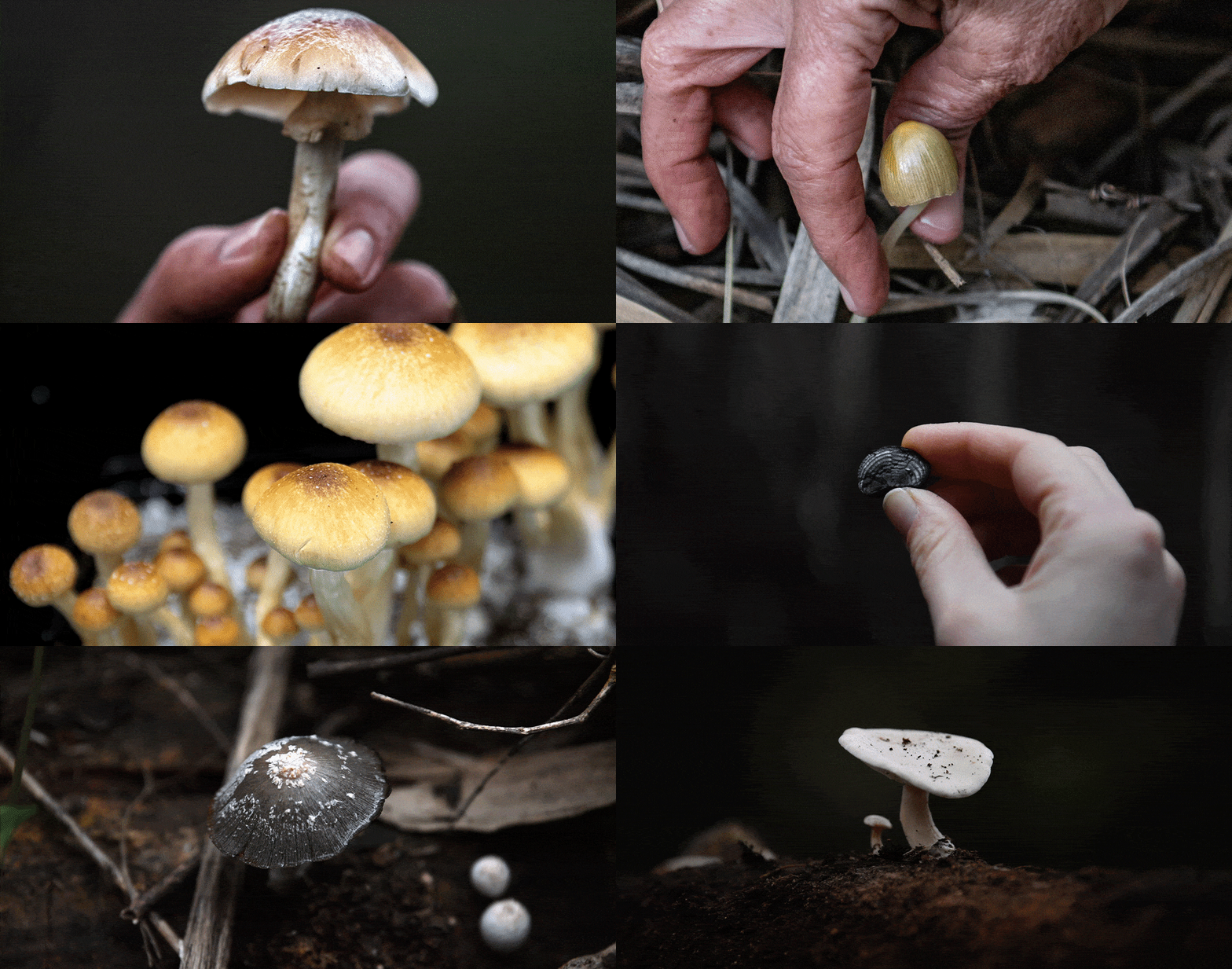
“At the end of the outing there’s no supper,” Zaarur asserts, to preempt any disappointment among the group that gathered around him some weeks ago, on the banks of the Kiryat Shmona Stream. We are entering a thick woodland; until dusk we will slowly trod on muddy trails in an effort to discover mushrooms that sprout on trunks of rotting trees, that are stuck to reeds, hiding amid weeds or peeping out between rocks. Even if they are considered to be edible mushrooms, we will behave with them like we do with protected flora and fauna on a safari: This is a feast for the eyes only.
Dr. Levinson, the mycologist, shows us a mushroom that resembles a human ear and whose surface feels like human skin. In the guides to fungi that were published in Israel in the 1950s, it’s called Auricularia auricula-juda, or “wood ear.” (It was originally called aznonit Yehuda, or “Jew’s ear,” in Hebrew but its name was changed because of its antisemitic overtone.)
A few steps away we encounter schizophyllum – a small, fan-like fungus attached to a branch, which we pass from hand to hand. Zaarur cautions us not to sniff it strongly. There have been those who have inhaled too deeply and ended up in the hospital; it turned out that they had breathed in spores, which thought they’d found a juicy host and started to develop in the sniffers’ respiratory tract.

In some cases, mushrooms are on the hosting side of the symbiosis. “One time I missed out on a high-quality natural schnitzel when I realized that it was a habitat for a rare beetle,” Yaniv Segal, a citizen mycologist and mushroom-gathering guide tells us, referring to a highly charged encounter with Laetiporus sulphureus, aka “chicken of the forest,” usually known for its flavor and fleshy texture.
In the same vein, a few years ago, Segal found an unusual, young mushroom growing out of a carob tree. He decided to leave it and wait for the meal to develop. “But when I went back to pick it, I discovered that larvae and beetles were living in it. On the way home, frustrated, it struck me: If the mushroom was rare, maybe the beetles and the larvae were also rare?” Indeed, Segal had chanced upon a beetle so rare that it didn’t yet have a Hebrew name. So the culinary urges were shunted aside in favor of preserving eco-diversity.
In Israel no mushrooms have been declared protected species. In contrast to flora and fauna – which by law must be searched for and identified before any sort of road-paving or construction can take place – fungi are not taken into account. For one, Levinson says she dreams of a declaration of a “fallow year” when it will be forbidden to gather mushrooms, and thereby reduce the risk that rare species will become extinct.
Fungi have essential, sometimes even exclusive, roles in certain realms. The planet depends on their “skills” in dealing with organic waste. Thus, the extinction of certain types of fungus can mean the loss of a valuable component of the ecosystem and a massive build-up of such waste, whose disposal is likely to be a complicated, expensive process that pollutes the environment.
To protect their fungi, some countries have recommended that hikers use special trails or have redirected them to new paths in wooded areas, for two reasons: to keep gatherers away and to avoid the trampling of mycelium. A few European countries have limited the gathering of mushrooms to as many as one can hold in one’s hand.
“When you go into the woodlands,” Zaarur says, “don’t measure your success by the amount of mushrooms you’ve collected in the basket, but rather by the mushrooms you left behind.”